

District technology leaders know that many support needs actually start as questions.
How do I report a damaged student Chromebook? How do I get access to this application? How do I get a replacement smart board?
A traditional chatbot can answer the question. But it can’t actually resolve the underlying need. That part typically falls on people. Someone needs to gather information, create a request, secure approval, coordinate across teams, and track the work through completion.
This is where agentic AI can reduce the coordination burden required to deliver support. It can use district knowledge to answer a question, understand the user’s intent, gather the necessary context, and initiate the appropriate next step.
For K–12 technology teams expected to maintain service levels with leaner teams and tighter budgets, that distinction matters.
What’s the Difference Between a Chatbot and an AI Agent?
District support requests often start with a question:
- How do I get access to this application?
- What’s the process for replacing a damaged student device?
- Which form does a new employee need?
- Who handles a classroom temperature issue?
- Has my reimbursement request been received?
Chatbots and AI agents can both help people find answers. The difference lies in what happens next.
A chatbot responds. An AI agent responds and determines what needs to happen next.
A traditional chatbot might point someone to a policy, form, or department. An AI agent can recognize when the question is actually signalling a request, then it uses district knowledge to determine the appropriate next step, and help move the work forward.
The agent doesn’t simply provide a better answer. It recognizes when an answer is not enough.
How Agentic AI Turns District Knowledge Into Action
Consider how agentic AI could improve the process of replacing a damaged Chromebook.
A teacher reports a damaged Chromebook and asks how to get it replaced.
A chatbot can find the relevant policy or form and direct the teacher to the correct process.
An AI agent will:
- Identify the requester and relevant context, such as their school and classroom.
- Provide immediate guidance based on district policy.
- Gather missing details, such as the student, device, and type of damage.
- Create a support request with the necessary context.
- Route the request to the appropriate team or helpdesk.
- Keep the requester informed as the work progresses.
Instead of leaving the requester to translate an answer into action, the agent initiates the appropriate district workflow.
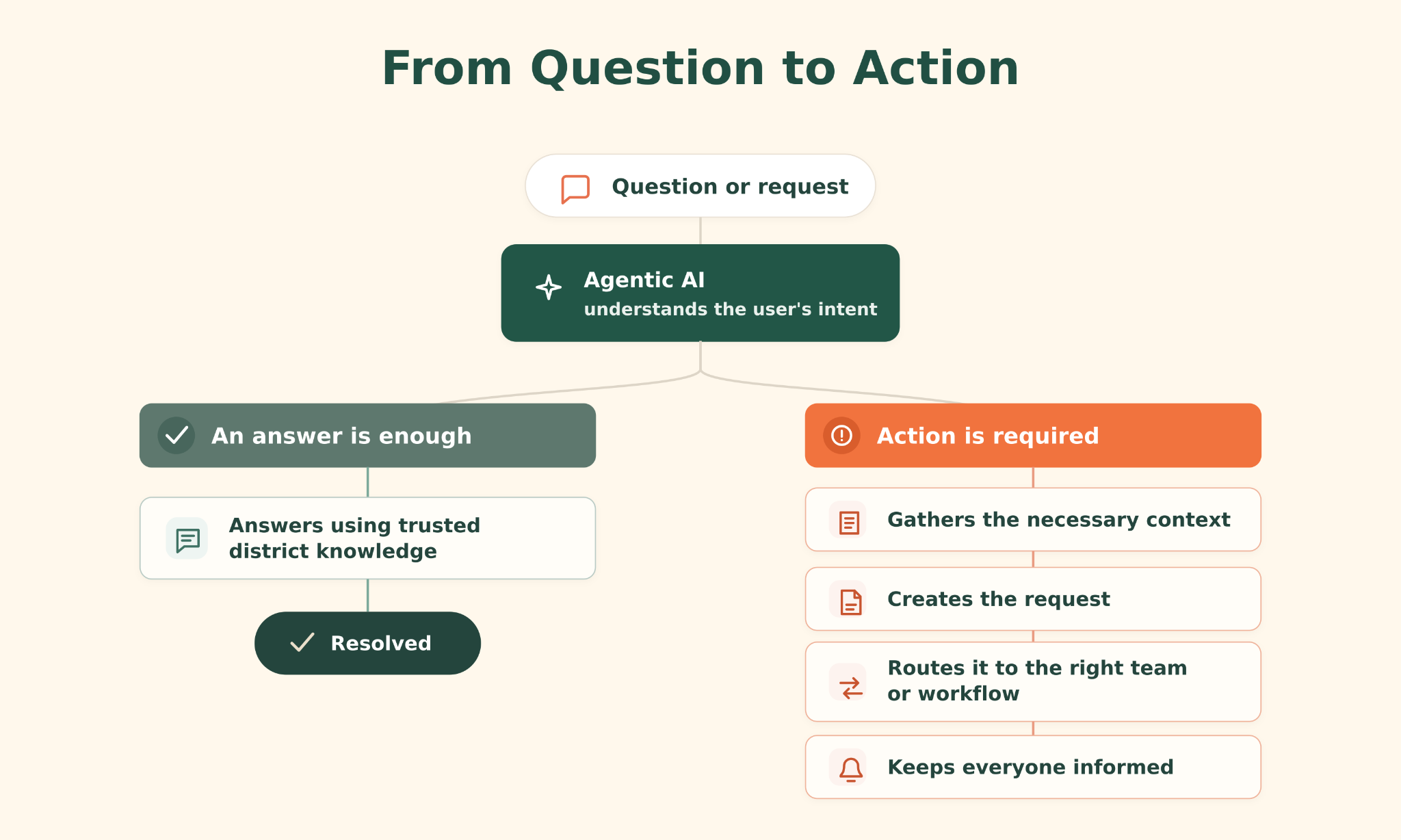
The same pattern can apply across departments. A question about application access could become an approval request. A facilities concern could be documented and routed to the appropriate team. A new employee could receive the right forms and guidance based on their role.
In each case, district knowledge helps the AI understand not only what to say, but what needs to happen next.
Why AI Agents Need a District Knowledge Layer
An AI agent cannot take the right action without the right context.
It needs to understand more than the words in a question. It may also need to know:
- Who is asking
- What school or department they belong to
- Which device, application, facility, or process is involved
- What district policies apply
- Which team owns the request
- What information that team needs
- Which systems and workflows should be used
- What information the requester is permitted to access
This is where a district knowledge layer becomes especially valuable.
A knowledge layer connects AI to trusted information across district-approved sources, giving it the context to find and use the right information. District websites, calendars, policies, student information systems, helpdesks, finance platforms, and departmental tools can remain where they are. The AI can work alongside those systems and workflows rather than requiring the district to recreate all of its information in another knowledge base.
The result is more than a quick answer. The agent has the context to connect that answer to the right request, workflow, or team.
What Agentic AI Can Do in School District Operations
Most people asking for help don’t know which department owns their issue or which system they’re expected to use. Nor should they have to.
Let’s say a teacher submits a question like “I can’t access the new reading platform.”
An AI agent can use district context to determine whether to:
- Answer the question when trusted information is sufficient
- Ask a focused follow-up question when information is missing
- Create and route a request when someone needs to act
- Connect the requester to an existing service or workflow
- Escalate the issue when approval or human judgment is required
The requester doesn’t need to diagnose the problem, choose a department, or understand the district’s organizational structure before asking for help. The agent helps navigate that complexity for them.
At the same time, the team responsible receives a properly routed request with the relevant context already included, reducing the need to track down information or reroute the work.
How School Districts Can Keep People in Control of AI
Turning knowledge into action does not mean removing people from district operations.
District teams still own their policies, processes, and source information. They decide which actions AI may initiate, what information different users may access, when approvals are required, and where human review belongs.
The goal is to let AI handle routine coordination while people retain authority over decisions, exceptions, and approvals.
AI can gather context, apply established rules, prepare requests, and surface the appropriate workflow. District teams remain responsible for the judgment and relationships that require their expertise.
Actions should remain visible and traceable so district teams can review what happened, maintain oversight, and improve processes over time.
From AI Answers to Better District Operations
For district technology teams, AI can do more than answer questions and deflect tickets. Its greater value is reducing the coordination required to deliver support, so leaner teams can maintain service levels and meet growing demands despite tighter budgets.
schoolAgent gives districts a single front door for questions and requests. It uses trusted district knowledge to answer questions, create requests when support is needed, and automatically route work to the right team.

.png)