

District knowledge is constantly changing. Policies are revised. Procedures evolve. Technology changes.
Every time something changes, the district needs to update the source of that information. But if the same information has also been turned into a knowledge base article, FAQ, or other support content, someone has to make sure that version stays current, too.
This is why traditional knowledge bases are so hard to maintain. But agentic AI makes it possible for districts to maintain and deliver current information without continually recreating their knowledge in a separate knowledge base.
The Hidden Work Behind Knowledge Base Maintenance
Districts will always need to maintain their source information. HR needs to keep policies accurate. IT needs current technical documentation. Finance needs up-to-date procedures.
Traditional knowledge bases add another layer on top of those distributed sources, creating Hidden Work for district teams. Information has to be gathered, organized, and turned into articles or answers. Then, as the source information changes, someone has to keep the knowledge base aligned with it.
But because knowledge ownership is distributed across the district, the people who know when something has changed aren’t necessarily the same people responsible for maintaining the knowledge base.
And the problem multiplies when districts maintain separate knowledge resources for employees, families, IT support, or individual departments.
How an AI Knowledge Layer Changes Knowledge Management
Agentic AI creates a different approach to district knowledge management.
Rather than requiring someone to anticipate questions and manually create and maintain answers, AI can build a knowledge layer from the information the district already owns.
Think of a knowledge layer as the connection between a district’s trusted source information and the people who need it. Instead of requiring teams to recreate that information as articles and answers, the knowledge layer makes the sources themselves usable.
HR can continue to own HR policies. IT can maintain technical documentation. Finance can update purchasing procedures. The knowledge doesn’t have to be centrally owned or recreated in a single repository to become useful. It only needs to be current.
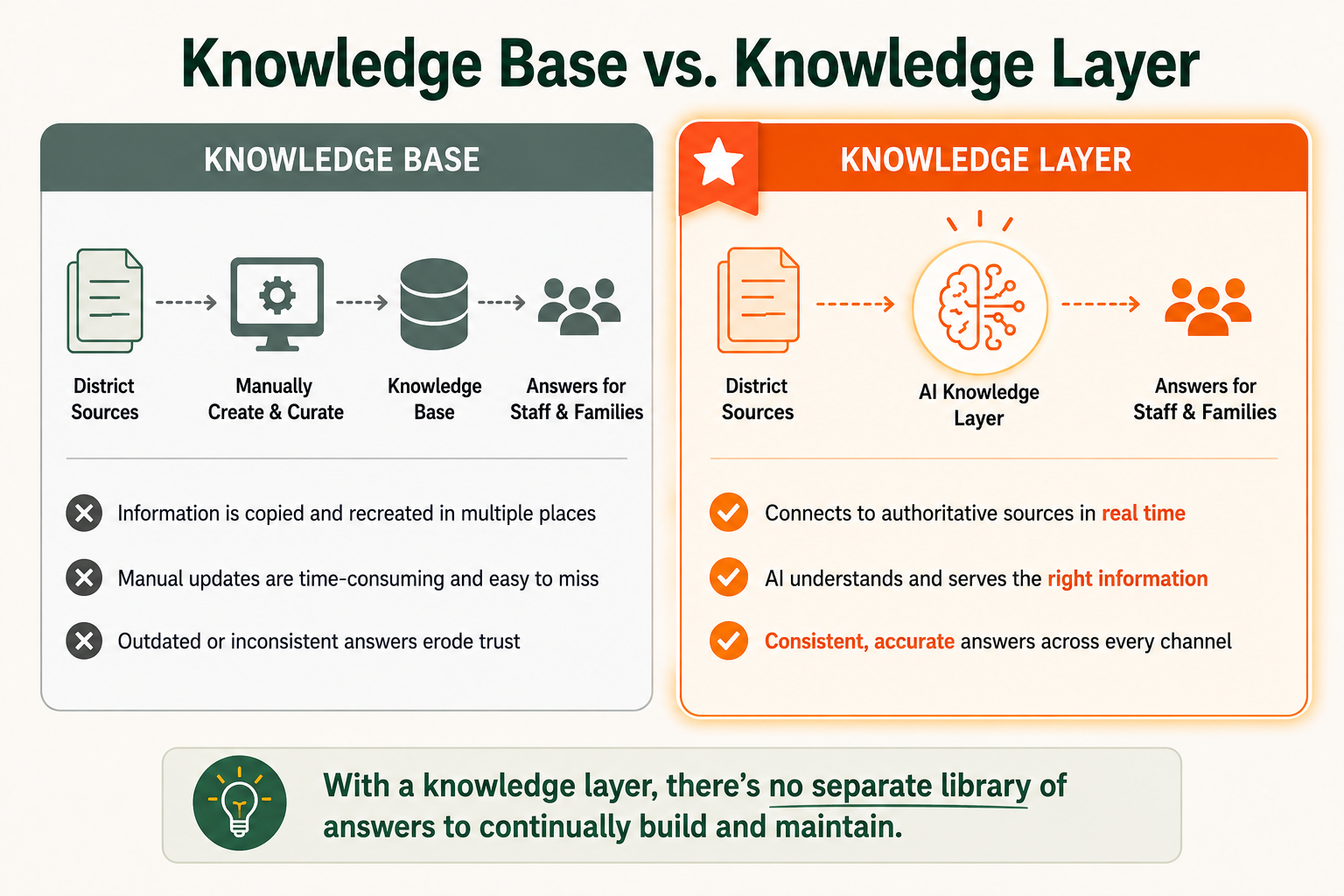
How Agentic AI Reduces Knowledge Management Work
As AI takes on a larger role in answering questions and providing support, keeping the knowledge behind it accurate and current becomes even more important.
Agentic AI goes beyond simply adding AI search to a traditional knowledge base.
schoolOS’ agentic AI can bring together information from district websites, documents, your technical support KB, and other trusted sources to create and maintain a knowledge layer. Instead of requiring district teams to manually assemble that information into a new repository, much of the work can happen automatically.
schoolAgent can then use that knowledge layer to provide answers grounded in district information.
As teams update their source information, the knowledge layer can reflect those changes in near real time. That means an HR policy can remain owned by HR, for example, without someone having to manually recreate every change in a separate library of answers.
Your district still owns its knowledge. You simply have less secondary maintenance to do.
A Better Way to Manage K-12 District Knowledge
For years, making district knowledge easier to use has often meant creating another place to put it.
Agentic AI changes that equation.
Instead of asking district teams to continually build and maintain separate collections of answers, a knowledge layer can make the information they already maintain accessible and usable.
District teams still own the important work of keeping their source information accurate. But they no longer have to do all the secondary work required to make that information accessible.
See how schoolAgent turns your district knowledge into answers. →

.png)