

School district IT teams receive all kinds of requests that don’t belong to them.
A teacher emails IT with a payroll question. A principal submits a facilities issue through the technology helpdesk. A new school counselor contacts IT because they can't figure out how to enroll in benefits.
At first glance, these requests might seem like a minor annoyance. Someone just needs to point them in the right direction or redirect the request, then move on.
But when this happens dozens of times a day across a district, the cost quickly adds up. Every misrouted request interrupts work, delays resolution, and pulls valuable time away from keeping district technology running, supporting classrooms, and solving real technical issues.
It's tempting to blame misrouted requests on the people submitting them. After all, shouldn't employees know where to go for help?
Not necessarily.
Today's school districts are complex organizations. In addition to doing their jobs, teachers and staff are expected to navigate departments, systems, forms, and processes when they need help. Even the most experienced employees can't be expected to know exactly where every question belongs.
That's why misrouted district requests aren't really a people problem.
They're a symptom that getting help has become unnecessarily complicated.
When people aren't sure where to go for help, IT becomes the default destination.
And when IT becomes the default destination, your IT team is forced to spend valuable time triaging misrouted requests that were never theirs to begin with.
Why Misrouted Requests Keep Happening
It's easy to assume misrouted requests happen because employees don't know the right process.
In reality, most people are simply doing what you'd expect: they're trying to get help as quickly as possible.
The challenge is that today's school districts are more operationally complex than ever. A request could belong to IT, Human Resources, Facilities, Finance, Curriculum, Transportation, or be shared by two or more departments. Ownership isn't always obvious, and the right answer often depends on the details.
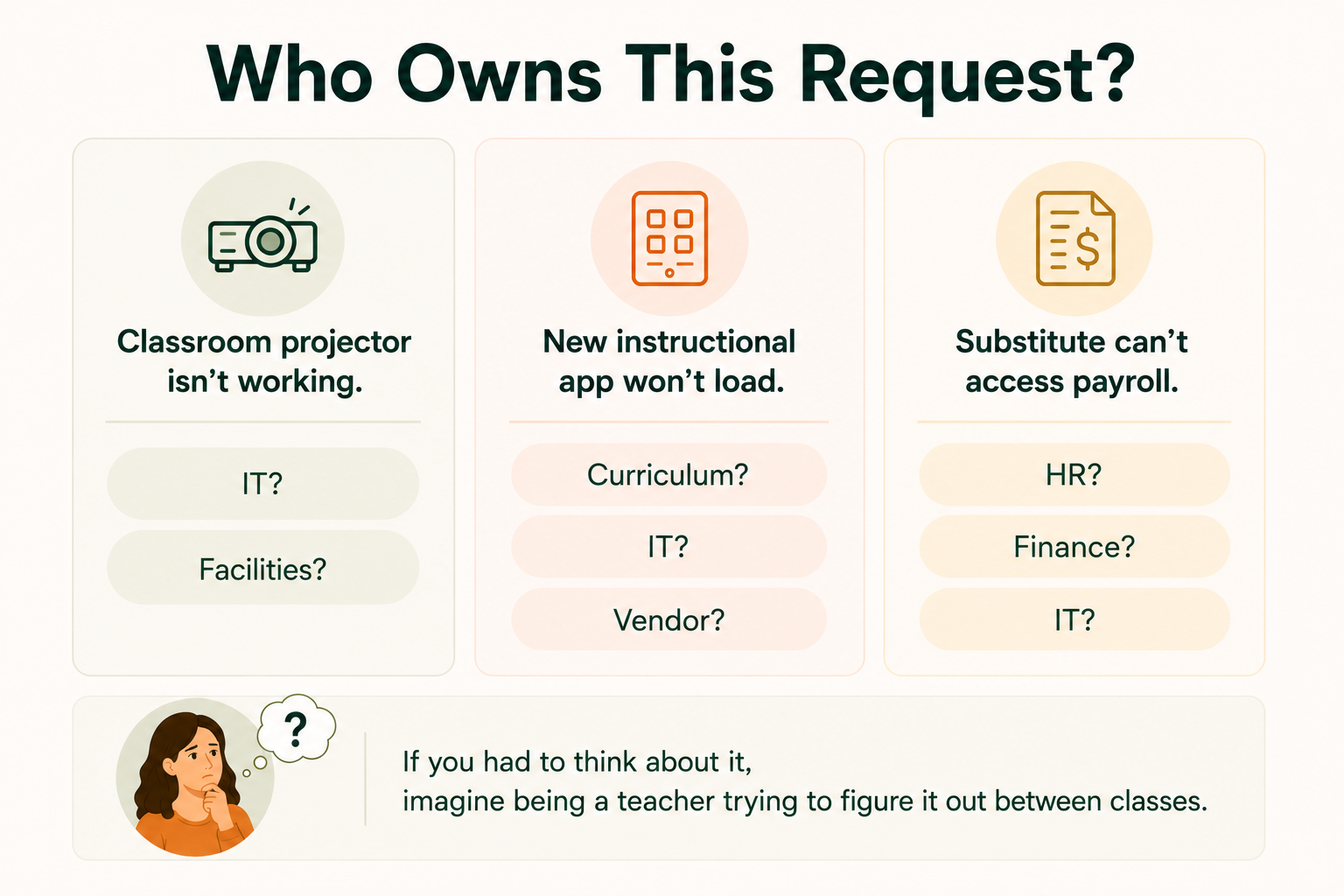
So people do what anyone would do: they make their best guess.
Sometimes they guess correctly. But often, they do not.
When that happens, the request doesn't disappear. It lands with the wrong team, often IT, where someone has to determine who actually owns it.
When IT Becomes the District’s Default Destination for Help
For every misrouted request, someone has to read the request, figure out who's responsible for solving it, gather any missing information, and either answer it or send it to the right team. Even when that process takes only a few minutes, those minutes add up across thousands of requests each year.
These are the hidden costs of becoming the district's default destination for help.
IT isn't just solving technology problems. It's answering questions, interpreting district processes, explaining who owns what, and redirecting requests that never belonged there in the first place.
Most districts don't measure this hidden work because it isn't neatly captured as a ticket category or performance metric. So it quietly becomes an accepted part of the day-to-day workload.
Yet, every unnecessary interruption delays work on classroom technology, infrastructure, cybersecurity, and the countless other responsibilities districts rely on IT to manage. While the costs of this hidden work may be hard to quantify, they’re significant when IT has become the default destination for help.
Want to see how much of your IT team's technical capacity is being consumed by Hidden Work? Use the Hidden Work Calculator.
Why More Training Won't Solve the Problem
When misrouted requests become a persistent problem, districts often respond with familiar training tactics designed to make it clearer where people should go for help.
They update the staff handbook or intranet. Publish "Who do I contact?" directories. Send reminders at the beginning of the school year. Create new request forms or department-specific email addresses. Ask principals to reinforce support processes with their staff.
These efforts are well intentioned, and they may even produce some improvements.
But they’ll never really solve the problem because they all rely on the same shaky assumption: that employees should know where to go before they ask for help.
For today's school districts, that's an increasingly difficult expectation to meet.
The goal shouldn't be training teachers and staff to become experts in district support processes. It should be making it easier for them to get help.
Today's school districts are complex organizations where responsibilities, systems, and workflows span multiple departments. Even when ownership is clearly defined, it isn't always obvious to the person who needs help in a hurry.
Consider a teacher who can't access a new instructional application. Is it an IT issue? A curriculum issue? A licensing issue? Or is there simply a missing approval somewhere in the process?
Teachers shouldn't be expected to know.
Expecting teachers and other staff members to understand the nuances of district operations places the burden on the wrong people. They shouldn’t need to become experts in district processes. They should be able to quickly get help, regardless of who ultimately owns the problem.
Make It Easier to Get Help Across Your District
Reducing misrouted requests isn't solved by more training or better documentation.
It's solved by designing a better support experience.
Instead of asking employees to figure out who owns their problem, districts should ask: What do you need help with?
District support orchestration enables the system to determine the right path for each request based on the district's established processes, ownership, and policies.
Think about the problems teachers deal with:
"I need to get this projector working before first period."
"I can't access this application for today's lesson."
"I have six students without working Chromebooks."
Teachers shouldn't have to worry about following support protocol. They should be able to focus on their students.
When districts make it easier for educators and staff to ask for help, not determine who should provide it, the result is fewer misrouted requests, less hidden support work, and faster resolution.
Misrouted Requests Are a Symptom, Not the Real Problem
Reducing misrouted requests doesn't just make IT more productive. It reduces hidden work across your district, giving technology teams more time to support classrooms and giving educators more time to focus on students.
Want to see what a better support experience looks like?
Learn how schoolAgent makes it easier for teachers and staff to get help and for IT teams to reclaim their time.

.png)