

If you're a K-12 IT leader, you've probably heard some version of the same joke:
"If it plugs into the wall, it becomes IT's responsibility."
Today, the joke feels more relevant than ever.
Security cameras. Interactive displays. Visitor management. Payroll systems. Building automation. Classroom technology.
As technology has become part of nearly every district function, IT's responsibilities have naturally expanded. That expansion can make it feel like IT is perpetually understaffed.
But many IT leaders would argue that something else has expanded, too.
Not just the technical work, but also the amount of work required before the technical work can start.
IT Is Increasingly Asked to Do More Than Technical Work
Imagine a teacher needs a new interactive display for her classroom.
Who should she contact? IT? Curriculum? Purchasing? Administration?
Unclear about who’s responsible for the decision, she defaults to IT.
Now imagine a principal wants another security camera installed.
Again, the request lands with IT.
Neither request is unreasonable. Technology is certainly a part of both.
But neither request is clearly an IT responsibility, either.
When ownership isn’t obvious, someone has to field the request. Someone also has to involve the right departments, coordinate next steps, and keep the work moving.
That "someone" is often IT.
Why Does Everything End Up With IT?
Sometimes it’s because employees simply don't know who to contact.
But the challenge runs deeper.
Technology has become embedded in nearly every district service. As a result, many requests no longer belong neatly to a single department. They span multiple departments, each responsible for a different part of the outcome.
An interactive classroom display may involve both Facilities and IT.
Application access is shared by Curriculum and IT.
A security camera requires collaboration between Security, Facilities, and IT.
When work spans multiple departments, ownership becomes even less obvious from the employee's perspective. Rather than trying to navigate the district's organizational structure, people naturally default to the department most closely associated with technology and most likely to respond.
That department is IT.
Every request that defaults to IT creates more work for IT.
Most districts aren’t measuring this work but it happens every day.
We call it Hidden Work.
And it's one of the least visible reasons district IT teams lose technical capacity over time.
Could Hidden Work be quietly consuming your IT team's technical capacity? Read Before Hiring More IT Staff, Ask These 5 Questions.
What Is Hidden Work?
When people think about IT work, they usually picture technicians doing technical work, like troubleshooting devices, maintaining the network, deploying new technology, or strengthening cybersecurity.
But at least a portion of the day is spent on other work:
- Fielding informal requests for help
- Evaluating who else should be involved in a request
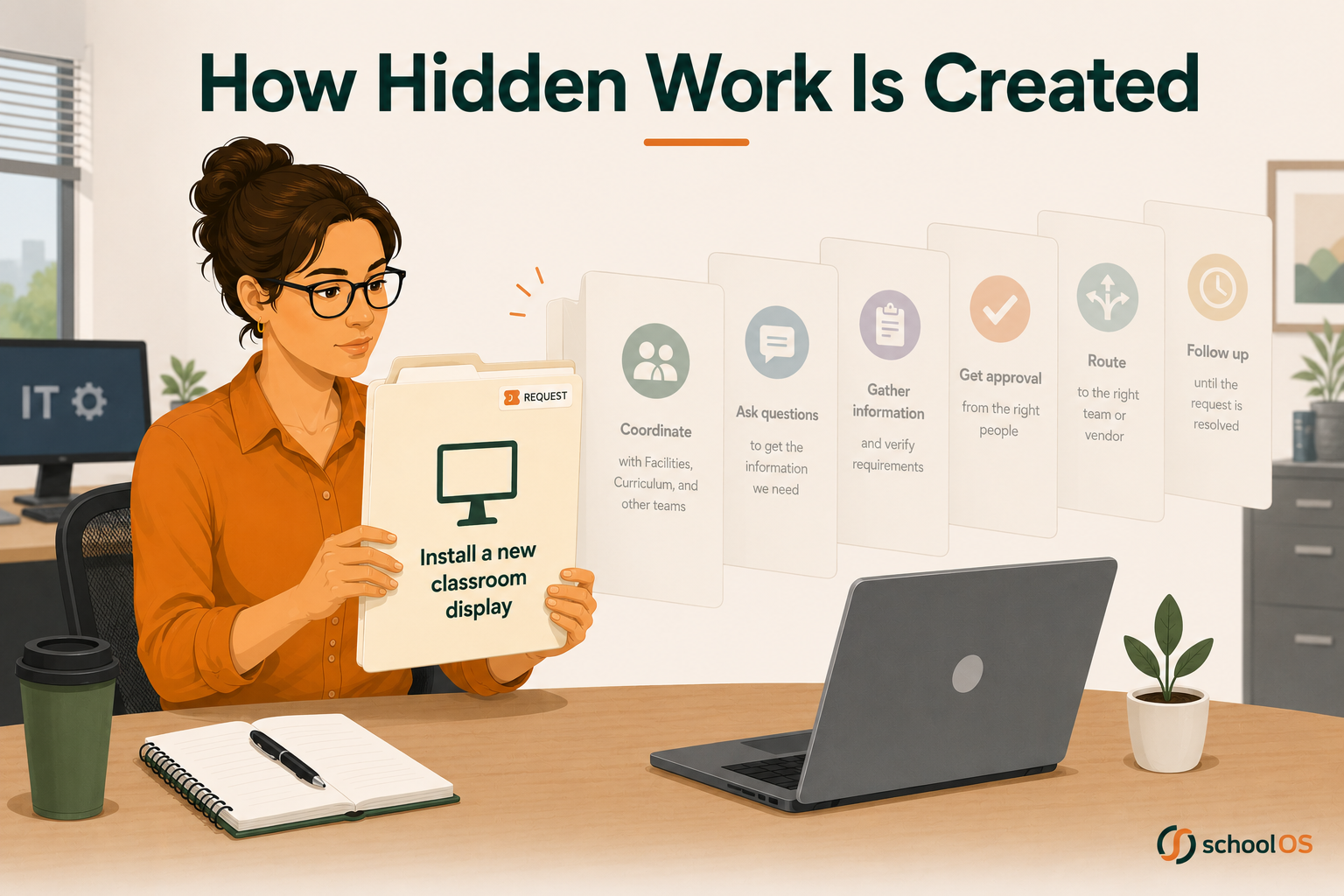
- Gathering missing ticket information
- Coordinating with other departments
- Following up on status and approvals
None of these activities are unimportant. In fact, they're often essential to delivering district services.
Collectively, though, they represent a significant amount of work. This is Hidden Work.
Hidden Work is the additional operational effort required to compensate for fragmented support experiences, disconnected systems, and the manual coordination needed to deliver district services.
It’s a part of doing IT work, but it isn't technical work.
And because it typically requires only a few minutes, it’s often accepted as just part of the job.
The Cost of Hidden Work
A few minutes here and there doesn't seem significant.
One more repetitive question doesn't seem like a problem. It’s no big deal to reroute one more request that doesn’t belong to IT, right?
But Hidden Work adds up.
Over the course of a school year, those seemingly small moments quietly consume dozens, maybe hundreds, of hours that could have been spent strengthening cybersecurity, modernizing infrastructure, supporting instruction, or completing strategic technology initiatives.
Want to see how much of your IT team's technical capacity is being consumed by Hidden Work? Use the Hidden Work Calculator.
That's why Hidden Work isn't simply an efficiency problem. It's one of the reasons districts experience what feels like an IT staffing shortage. In reality, it's a technical capacity problem.
The more time IT spends coordinating work, the less time it has available for the technical work only IT can perform.
Collaboration Is Needed, But It Needs to Be Easier
Modern school districts depend on collaboration between IT, Curriculum, HR, Finance, Facilities, Transportation, and many other departments.
The challenge is that collaboration often depends on manual coordination.
Employees have to figure out where to go for help. IT has to determine who else should be involved. Departments have to coordinate the work cross-functionally through emails, phone calls, meetings, and follow-up conversations.
District support orchestration is specifically designed to reduce this manual coordination .
A Better Support Experience Improves Collaboration While Reducing Hidden Work
Employees shouldn't have to understand the district's organizational structure before submitting a request.
Nor should IT have to manually coordinate every request that crosses departmental boundaries.
A better support experience can ensure requests include the right teams, the necessary information is gathered upfront, and everyone involved has shared visibility.
The result is less Hidden Work. And faster service delivery.
Technology will continue to touch every district function. That doesn't mean IT should have to coordinate every technology-enabled request.
For many districts, reducing Hidden Work can quickly expand technical capacity without adding headcount.
Learn how schoolAgent makes it easier for teachers and staff to get help and for district IT teams to reduce Hidden Work.

.png)