

A teacher needs help with a classroom projector.
They submit a ticket to IT.
An IT technician investigates the issue and discovers the projector is working correctly. The problem is actually related to the classroom AV system, which is managed by Facilities.
The ticket is reassigned.
A few emails are exchanged. Additional information is requested. Eventually, the request reaches the right team and the issue is resolved.
Situations like this happen every day in school districts.
It’s not because employees are careless or support teams are ineffective. Most of the time, it’s because people simply aren’t sure where to go for help. And, compounding the problem, every team lives behind their own, unconnected system.
As a result, requests often land with the wrong department before finding their way to the right one. And that department is often IT.
Why Misrouted Requests Matter
Misrouted requests aren’t just annoying, they create additional work. Someone has to review the request, determine ownership, redirect it, and communicate with the requester. What might have been resolved quickly can take significantly longer when requests bounce between teams. In some cases, a simple issue can be delayed by days before it reaches the people equipped to solve it.
When support requests repeatedly land with IT, technology teams end up spending valuable time reviewing, rerouting, and coordinating work instead of resolving tickets and supporting users. This “hidden work” is rarely quantified, but it could be stealing dozens if not hundreds of hours over the course of a school year.
Use the Hidden Work Calculator to estimate how much of your IT team's time is being consumed by manual coordination.
The impact extends beyond the IT department, too. When classroom technology, facilities, transportation, or other operational issues remain unresolved, staff lose time, students experience disruptions, and instructional time can be affected.
What Is a Misrouted Request?
A misrouted request is any support request that reaches the wrong team before eventually being redirected to the right one.
Some common examples are:
- A facilities issue submitted to IT because technology is part of the problem
- A software access request sent to a school administrator instead of the technology team
- A transportation question sent to the front office because the requester isn't sure who owns it
- A new employee onboarding request that requires coordination between HR, IT, and other departments
In some cases, the requester chooses the wrong support channel. In others, ownership isn't clear, information is missing, or multiple departments are involved. Regardless of the cause, the result is the same: the request must be reviewed, reassigned, and communicated before work can begin.
Misrouted requests are common in school districts because support services span many teams. Technology, facilities, transportation, finance, human resources, and school operations all provide support in different ways. For employees, understanding who owns what issues isn't always straightforward.
That's why a request that belongs to one department often starts somewhere else.
The problem isn't the requests themselves. They're legitimate questions and issues that need attention. Many also have a direct impact on teaching and learning, which makes timely resolution even more important.
When requests start in the wrong place, however, they must be reviewed, reassigned, and redirected before the right team can begin working on them. Each handoff introduces delays, making quick resolution increasingly difficult.
Why IT Receives So Many Misrouted Requests
Misrouted requests are rarely the result of careless employees or poorly managed support teams. More often, they're the natural outcome of how support is delivered across most school districts.
Support Ownership Isn't Always Obvious
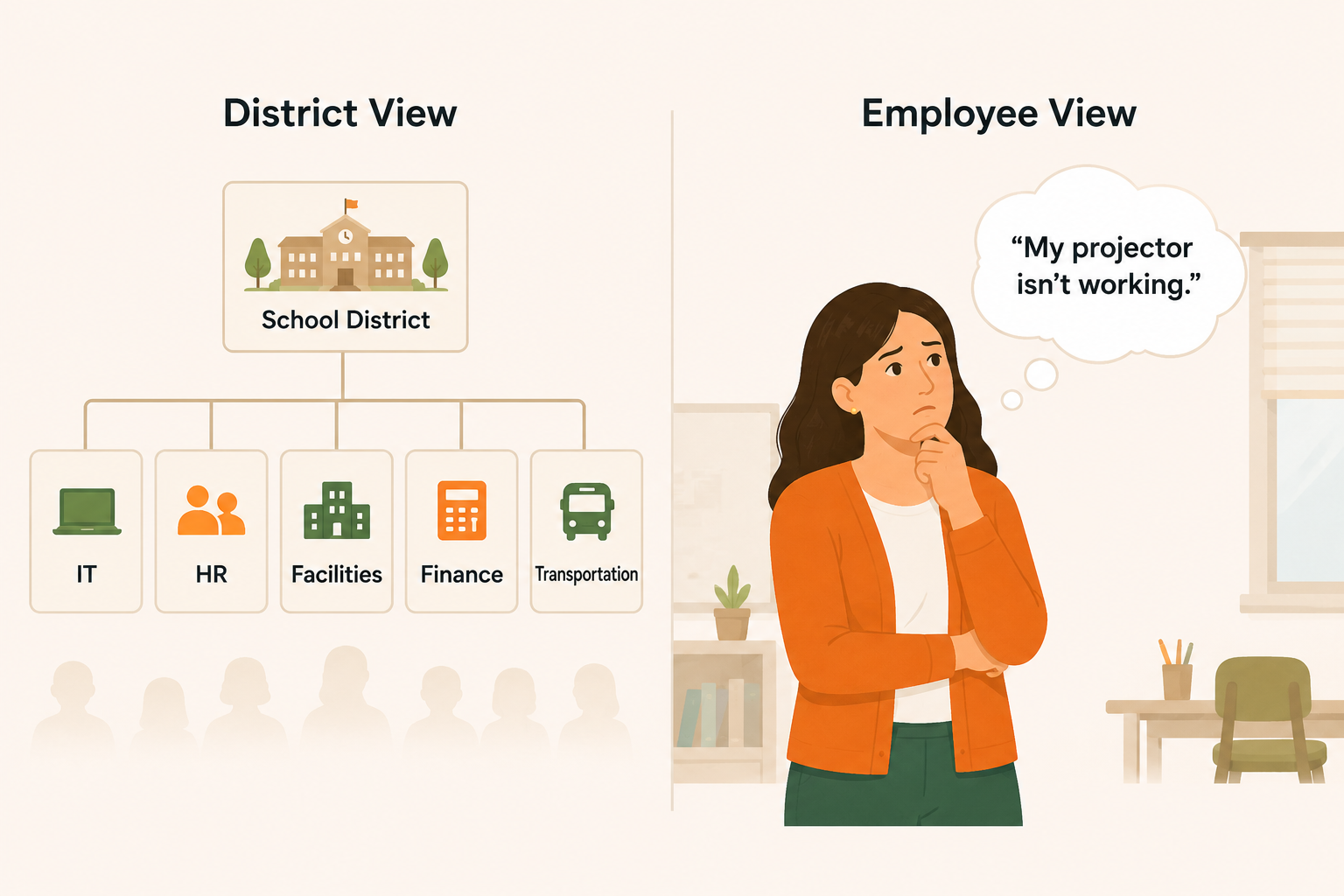
District services don’t fit neatly into organizational charts.
A classroom projector issue could involve technology, facilities, or both. New employee onboarding often requires coordination between HR, IT, and other departments. Many requests span multiple systems, teams, and processes.
Employees don’t think about departmental ownership when they need help. They simply want their problem solved.
So when ownership isn’t clear, requests naturally end up wherever the requester believes they're most likely to get a response.
IT Is the District's Default Help Desk
Technology teams are highly visible. Employees know how to reach them, they interact with them regularly, and they often have an established ticketing process. As a result, requests that belong elsewhere frequently end up in the IT queue.
A teacher who isn’t sure whether an issue involves classroom technology or facilities may submit a ticket to IT.
An employee with a question about software access may reach out to the helpdesk because it’s the support channel they know best.
Even when the request isn’t technology-related, IT often becomes the starting point because it’s the path of least resistance.
Support Exists Across Too Many Channels
The challenge is amplified when support requests can be submitted through multiple channels.
Employees may send an email, complete a form, submit a ticket, call the office, send a chat message, or simply ask someone they know. While offering multiple channels may seem like a good way to improve the support experience, these channels can also introduce confusion and make it harder for requests to reach the right team.
The result is a steady flow of requests that require review, reassignment, and follow-up before work can begin.
Misrouted requests can easily be mistaken for a ticket routing problem. In reality, they’re often the symptom of a bigger issue: employees don’t have a clear and consistent way to find help.
The Real Impact of Misrouted Requests
A single misrouted request may seem like a minor inconvenience. Most eventually reach the right team and get resolved.
The challenge is what happens in between.
Every misrouted request creates additional work before anyone can begin addressing the issue itself. Someone must review the request, determine ownership, gather missing information, communicate with the requester, and redirect the work to the appropriate team.
Individually, these tasks may only take a few minutes. Across dozens or hundreds of requests each month, however, the impact adds up quickly.
More Time Spent Triaging Requests
When requests arrive in the IT queue whether they belong there or not, IT also becomes responsible for determining where they do belong.
Most district IT teams aren't overwhelmed by IT work. They're overwhelmed by requests they don't own.
That means reviewing tickets, identifying the appropriate department, reassigning requests, and answering follow-up questions. None of this work moves the issue closer to resolution. It simply helps the request find its way to the right team.
Longer Resolution Times
The longer it takes for a request to reach the right team, the longer it takes for work to begin.
Each handoff introduces additional delays. A request may sit in a queue waiting to be reviewed, reassigned, or clarified before the responsible team is even aware it exists.
For employees waiting for help, these delays are frustrating. For issues that affect classrooms, they also disrupt teaching and learning.
More Follow-Up and Status Requests
When an employee isn’t sure who owns a request or whether it has reached the right team,
it can set off a chain of additional communications. They may send emails to check status. Or call the helpdesk. Or submit another request.
Each of these communications creates additional follow-up work, while providing little progress toward actual resolution.
Less Time for High-Value Work
Most district technology teams are already operating with limited staff and resources.
Every minute spent reviewing, rerouting, and coordinating requests is a minute that isn’t spent resolving tickets, supporting employees, maintaining systems, or working on strategic initiatives.
Over time, misrouted requests don’t just create inefficiency. They also reduce the capacity of the teams responsible for delivering support.
Why More Training Doesn’t Solve the Problem
When misrouted requests become a recurring issue, many districts respond by creating more documentation, offering additional training, or reminding employees where to submit requests.
These efforts can help. Employees need clear processes, and support teams benefit when expectations are communicated consistently.
The challenge is that most employees don’t think about support processes until they need help. Even when they have been trained, they may not remember which form to use, which department owns a service, or where to find the right support channel weeks or months later.
A teacher dealing with a classroom issue isn’t focused on departmental ownership. A new employee trying to access a system isn’t thinking about which team manages the request. They're focused on solving the problem in front of them.
As districts grow, the challenge is amplified. New systems are introduced, responsibilities shift between departments, and support processes evolve over time. Keeping every employee informed about every change is nearly impossible.
This is why misrouted requests persist even in well-run districts with strong communication and training programs.
Want to Reduce Misrouted Requests? Make it Easier for People to Get Help
When addressing the problem of misrouted requests, many districts focus on more training. A better approach is to make it easier for people to get help, regardless of how the district is organized.
Employees shouldn’t need to know which department owns a service, which form to complete, or which support channel to use. They simply need a clear and consistent way to ask for help.
When support is easier to access:
- Employees spend less time searching for answers
- Support teams spend less time rerouting work
- Issues can be resolved more quickly
In other words, the goal isn’t to teach everyone how your support organization works. The goal is to create a support experience that works for everyone.
What a Better Support Experience Looks Like
If misrouted requests are a symptom of employees struggling to find help, the solution isn't more training or stricter processes. It's creating a support experience that makes it easy for people to get the assistance they need.
While every district is different, the most effective approaches share a common goal: reducing the effort required to find help while ensuring requests reach the right team quickly.
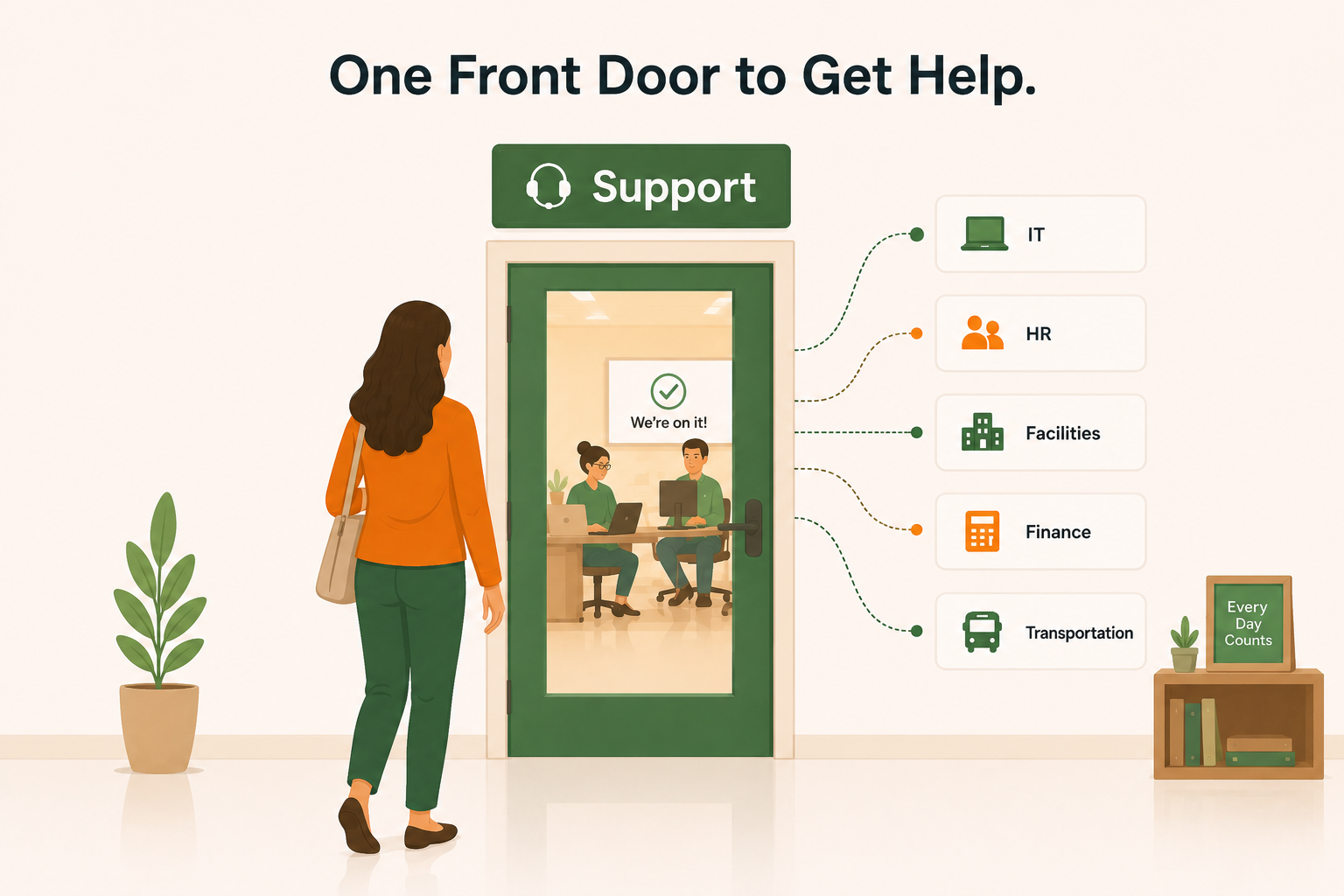
Create a Single Front Door for Support
The first step is giving employees one place to start when they need help.
Instead of asking employees to decide whether a question belongs with IT, Facilities, HR, Finance, or another department, a single front door removes the guesswork. Employees simply describe what they need.
Answer Questions Before They Become Tickets
Not every interaction needs to become a ticket.
Many employees are simply looking for information, such as how to request leave, access a system, reserve equipment, or complete a district process.
Providing answers before a request is created significantly reduces tickets while helping employees get what they need faster.
Gather Context Before Work Begins
When a request is necessary, collecting the right information up front helps reduce delays.
Relevant details, supporting information, and request context can be captured before the request reaches a team, reducing the need for follow-up and clarification.
Route Requests to the Right Team
When employees have a consistent place to start and requests include the necessary context, routing becomes much simpler.
The right team receives the request with the information needed to take action, reducing reassignment, minimizing delays, and helping issues get resolved more quickly.
Collectively, these steps are also known as district support orchestration, which is the practice of coordinating support work across departments, systems, workflows, and communication channels so people can get help more easily and teams can operate more effectively.
Better Support Starts with a Better Way to Get Help
Misrouted requests can seem like a ticket routing problem, but they’re more often the symptom of a support navigation problem.
When employees aren’t sure where to go for help, requests are bound to end up in the wrong place. IT becomes the default destination. Support teams end up reviewing and redirecting work, when their time could be better spent addressing real problems.
As a result, issues also take longer to resolve than they should. And delayed resolution is frustrating for everyone involved, not to mention being disruptive to teaching and learning.
In districts across the country, people know this problem exists. But the toll is difficult to quantify and a solution has been evasive, so the problem continues to persist.
schoolAgent creates a support experience that helps people get the assistance they need while ensuring work reaches the right team with the right context.
The result isn’t just fewer misrouted requests. It’s better service delivery with less friction. Learn more at www.theschoolos.com/schoolagent

.png)