

In many school districts, IT teams manage far more than technology-related tickets.
Beyond password resets, devices, and application access, they often field questions and issues that aren’t theirs to resolve.
Why?
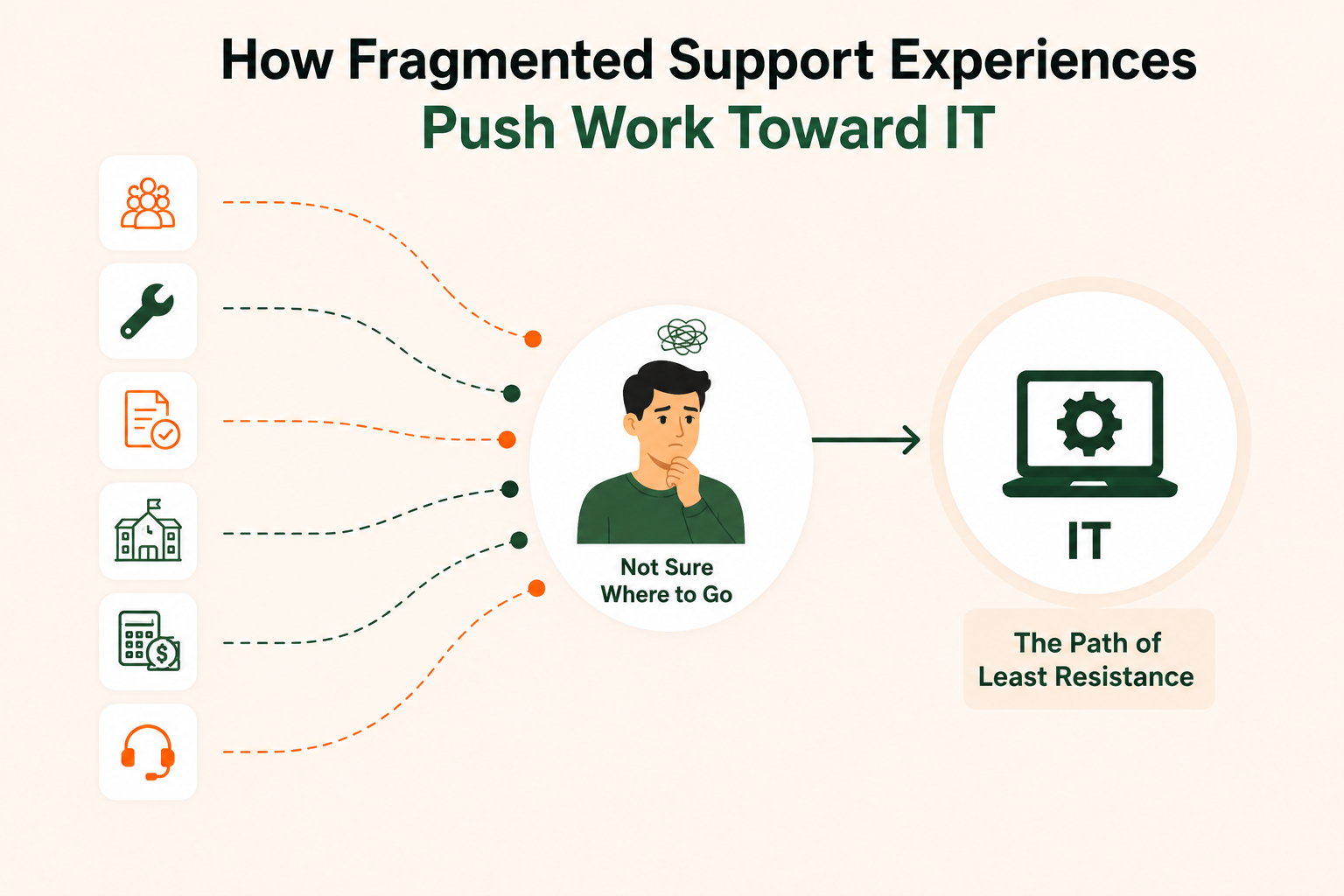
Because when people aren't sure where to go for help, IT becomes the path of least resistance.
5 Reasons Districtwide Questions End Up with IT
1. IT Has the Most Visible Support Process
Most departments don't have a formal support process. But IT does. So when teachers and staff have a question and don't know where to start, they gravitate toward the department with the most visible support structure.
2. Technology Touches Nearly Everything
A problem may originate in HR, curriculum, finance, or student services. But if a system or application is involved, people often assume IT owns the issue, whether that’s true or not.
3. People Don't Know Where Else to Go
Teachers and staff may not know which department owns a particular process, especially when responsibilities overlap. Rather than spend time figuring it out, they simply contact IT because it's the easiest option.
4. IT Has a Reputation for Being Helpful
District technology teams work hard to provide responsive support. As a result, the more consistently they solve problems, the more likely people are to bring unrelated issues to them as well.
5. Many Issues Are Cross-Departmental
Questions or issues involving more than one system, process, or department can be difficult to address. In the absence of a clear place to start, people often send multiple requests or default to IT.
Each of these factors contributes to district support requests landing with IT. But together they point to a larger issue: many districts lack a coordinated support experience that makes it clear where to go for help.
The Hidden Cost of Becoming the Default Support Hub
When IT becomes the default go-to for district support requests, the impact extends beyond ticket volume.
IT teams spend time:
- Redirecting requests to the correct department
- Gathering information that someone else needs
- Coordinating between multiple teams
- Following up on issues they don't actually own
Over time, these extra handoffs create hidden work across the district. People spend more time navigating support processes, IT spends more time coordinating requests it doesn't own, and other departments receive delayed or incomplete information.
Want to know how much of your IT team's time is being consumed by hidden work? Calculate your hidden work now.
This looks like isolated support issues or not enough IT capacity on the surface, but it actually indicates a bigger operational issue. And when district leaders lack visibility into how requests move across teams and systems, these operational inefficiencies often remain hidden.
How School Districts Can Reduce Misrouted Support Requests
IT shouldn’t need to be the gatekeeper. The solution lies in making it easier for people to get the help they need.
Districts can significantly reduce IT demand by doing just one thing:
Provide a Single Front Door for District Support
When someone needs help, they don't care which department owns the issue. They just want their question or issue resolved quickly.
Yet, in many districts, they don’t know where to go. Fragmented support processes and systems leave teachers and staff to figure things out for themselves. That's when their questions and issues often end up in the wrong place.
A better approach is to provide a single, consistent place where everyone, including teachers, staff, students, and community members, can go to get help, regardless of the nature of the issue.
Behind the scenes, requests are routed to the appropriate department. But from the requester’s perspective, the process is simple and predictable.
And when you make it easy for people to get help, not only are they less likely to default to IT, resolution is faster and more efficient for everyone involved.
The Solution to IT Overwhelm Isn’t Adding Capacity
Many questions that land with IT aren't actually technology issues.
Because of fragmented support experiences, people don’t know where to go for help.
When people aren't sure where to turn, they naturally gravitate toward the department they trust to respond. In many districts, that's IT.
When IT teams are overwhelmed, the obvious solution is to add capacity. But districts can significantly reduce demand on IT simply by making support easier to navigate in the first place.
Employees shouldn't need to understand complex organizational charts, department ownership, or support processes just to get help. They should have one clear path forward.
schoolOS connects district teams, systems, and workflows to create one front door for support. Learn more.
FAQs
Why do teachers contact IT for non-technical issues?
Many teachers aren't certain which department owns a particular issue. Because the IT department is visible, accessible, and responsive, it becomes the default place to ask for help.
What are misrouted support requests?
Misrouted requests are questions or issues that end up with a department that doesn't actually own or resolve them. These requests require additional coordination and handoffs, managed by the IT team, before they reach the right department.
How can school districts reduce IT ticket volume?
Districts can reduce unnecessary IT tickets by creating clear support pathways, standardizing intake processes, and routing requests to the appropriate department automatically.
Why are K-12 IT teams overwhelmed?
District technology leaders have their hands full managing technology demands, cybersecurity responsibilities, and staffing challenges. When the IT department also becomes the default destination for questions that belong elsewhere, teams end up coordinating non-technical issues that take them away from their core job responsibilities.

.png)