

Who keeps the information across your district current today?
It’s probably not a dedicated knowledge management team.
Instead, the people in HR, IT, Finance, Communications, and other departments are responsible for keeping their respective policies, processes, forms, and resources current.
But information rarely appears in just one place. A policy might be referenced on the district website, in a shared drive, a staff handbook, and who knows where else.
Someone needs to make sure it gets updated everywhere. Who is that in your district? And is there a better way?
Why It’s So Difficult to Maintain K-12 District Knowledge
Keeping district knowledge current requires more than updating a single document when something changes.
Because the same information often appears in several places, updates are rarely one and done. A department may make updates to a resource without realizing all the other places that resource exists. Another may revise a policy without realizing it conflicts with information somewhere else.
Traditional knowledge curation requires people to find those gaps and contradictions.
But many district personnel are already stretched in. This is where AI can take on the burden.
AI Can Find District Knowledge Gaps and Inconsistencies
An AI knowledge layer brings together information from the approved sources districts already maintain, then surfaces gaps or potential contradictions across them.
Imagine that HR updates an onboarding process, but another district resource still reflects the previous process. Rather than depending on someone to remember that the second resource exists, AI can surface the discrepancy for review.
Or perhaps people repeatedly ask a question that isn’t clearly answered in the available district information. AI can surface the gap so it can be addressed.
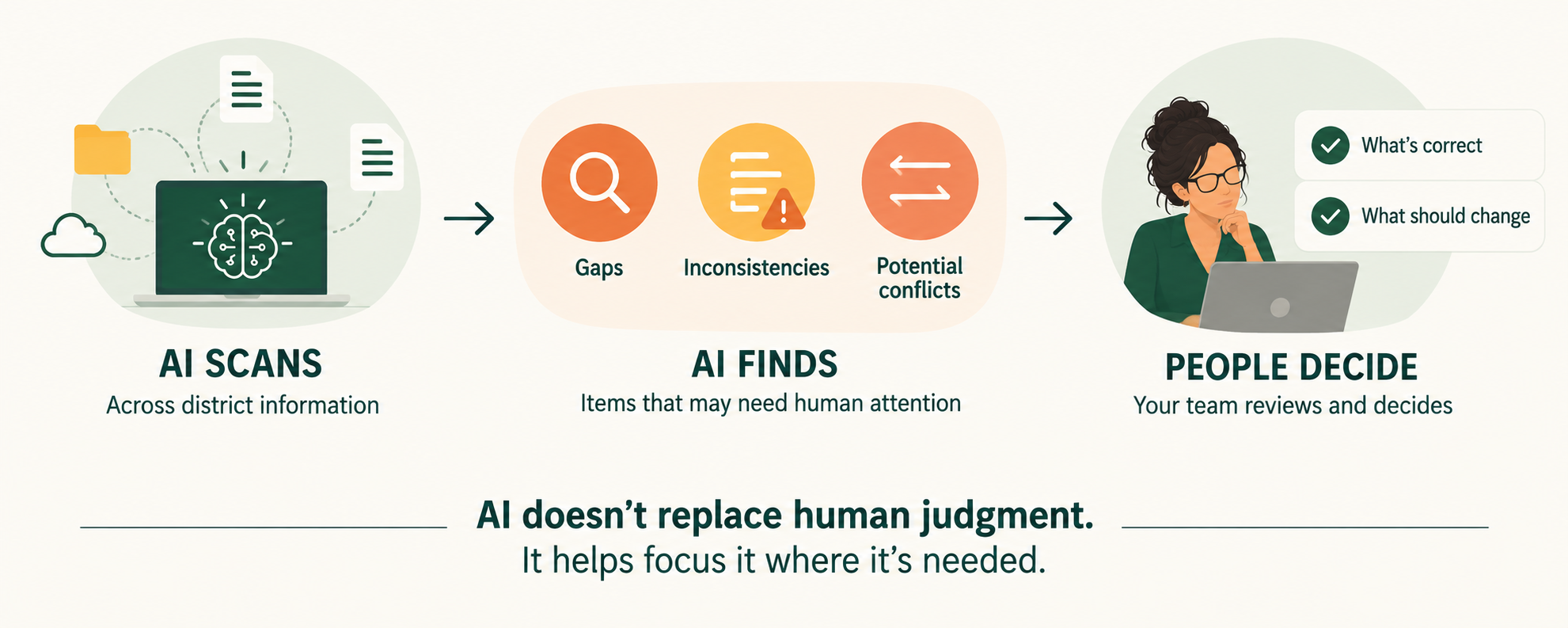
AI doesn’t decide which policy or process is correct. It alerts the people who own that knowledge so they can make the decision.
So instead of looking for problems, district staff can focus on resolving only the issues that require their attention.
More Than Putting a Chatbot on District Information
When people think about using AI for district knowledge management, it’s easy to picture a chatbot.
Someone asks a question. The chatbot searches the available information and provides an answer.
Chatbots are useful. But a chatbot that retrieves information and an AI agent aren’t the same thing.
Agentic AI is designed to work toward an objective. It can use context to determine what needs to happen next and take permitted steps toward that goal.
A chatbot answers questions. An AI agent answers questions AND determines what needs to happen next.
In knowledge management, that distinction makes a big difference.
A chatbot can use district knowledge to answer a question. Agentic AI can go further, helping identify where information may be incomplete or inconsistent and bringing those issues to the right people for review.
Let AI Do the Looking, Let People Provide the Judgment
People play an important role in managing district knowledge.
HR should decide what the district’s HR policies mean. Finance should own its processes. IT should determine its procedures. District leaders should make the decisions that require their expertise.
But instead of relying on those same people to identify knowledge inconsistencies and gaps, or even maintain a separate knowledge base, AI can take on much of that curation burden.
The people who know the district best remain in control. But their role shifts from maintaining consistency to resolving exceptions.
For resource-constrained district teams, that means less time managing information and more time focused on work that matters.
Centralize Knowledge Access and Simplify Curation
District knowledge will always change. The challenge is keeping up without turning knowledge management into another job.
AI offers a more manageable approach.
Rather than relying on people to continually review and reconcile information across the district, an AI knowledge layer centralizes access to the sources districts already maintain, eliminating the need for a separate knowledge base. AI then accesses that knowledge to provide answers, continually scans for gaps and inconsistencies, and notifies you when expertise and judgment are needed.
For more ways to make your district knowledge easier to access and keep current, check out schoolAgent. →

.png)