
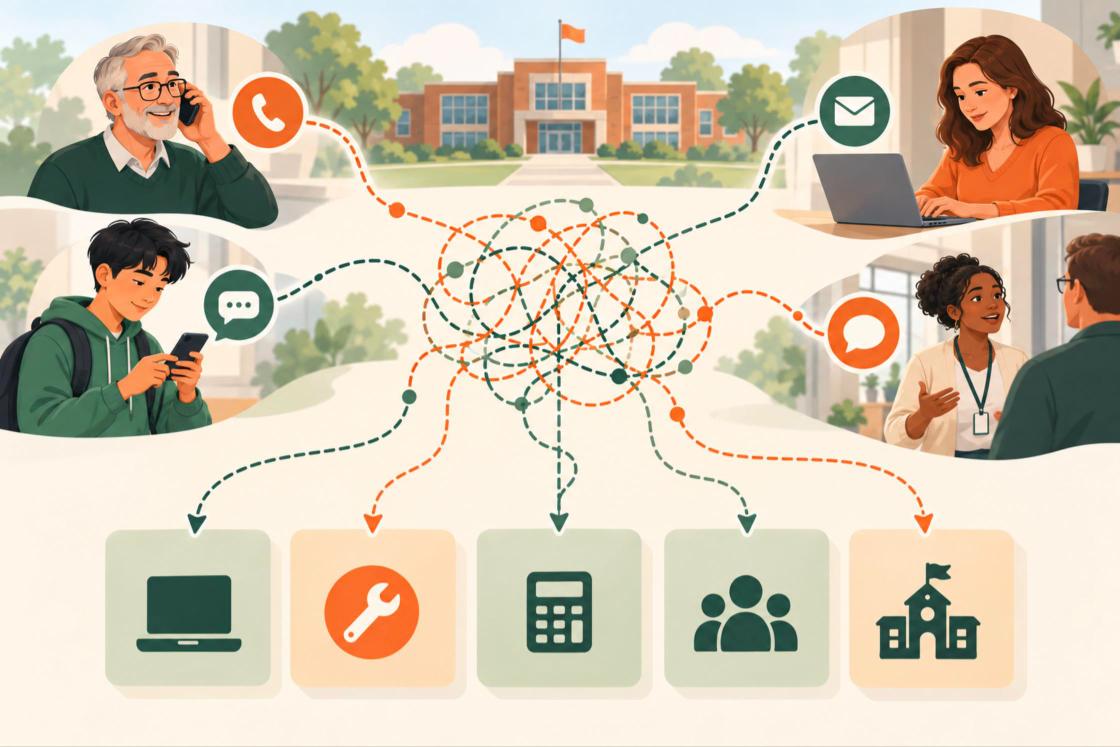
A parent calls the school looking for information about Friday’s football game.
A student needs a password reset.
A teacher emails about a classroom technology issue.
A staff member submits a facilities request through a form.
Another texts someone they know in the department.
These may seem like discrete operational challenges.
But they often share the same underlying problem:
There’s no consistent, connected way for people to get help across the district.
When support depends on inboxes, hallway conversations, phone calls, disconnected forms, and manual coordination between departments, even strong teams begin operating reactively. Over time, support teams become the human routing layer for the district.
And as districts have become more digitally connected, this coordination burden has significantly increased.
What Is Fragmented Support Intake?
Fragmented support intake happens when district requests arrive through too many disconnected channels, including email, chat, phone calls, forms, text messages, and in-person conversations. This makes it difficult for district teams to coordinate support, maintain visibility, and respond consistently.
The Problem Isn’t Just Ticket Volume
Many districts assume their operational challenge is reducing the number of support tickets.
But the real issue isn’t the volume of requests. It’s that requests arrive through too many entry points and coordination paths.
Support requests can come through email, helpdesks, online forms, phone calls, text messages, and even in-person conversations.
This creates operational friction from the moment a request is submitted.
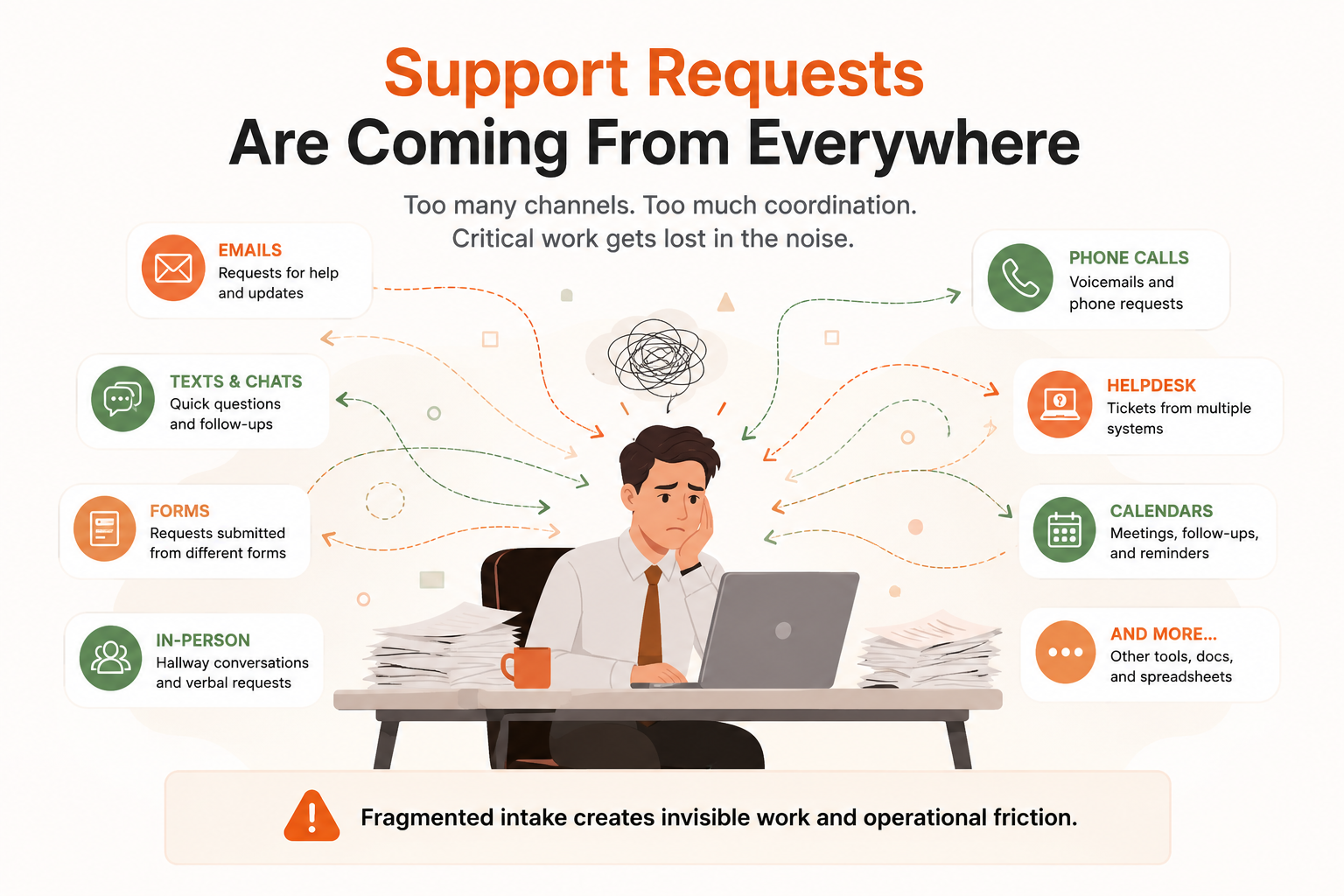
When intake is inconsistent and fragmented:
- requests often lack context
- prioritization becomes difficult
- work is duplicated across teams
- follow-up becomes inconsistent
- true workload isn’t recorded
Because requests are also scattered across different channels, it’s difficult to understand what’s actually happening across the district.
The problem isn’t just ticket volume. It’s fragmented coordination.
In fact, many districts trying to reduce IT helpdesk tickets are actually dealing with a broader operational coordination problem that traditional support workflows were never designed to solve.
Why People Bypass Formal Support Systems
People aren’t trying to make your job harder. They’re just trying to get help quickly.
When something feels urgent or disruptive, people naturally choose the path they believe will get the fastest response. That often means emailing someone directly, sending a text message, stopping by an office, or reaching out to a trusted contact.
In many districts, this behavior develops for understandable reasons:
- users may not know where requests belong
- formal systems may feel unclear or slow
- past experiences shape future behavior
- people rely on relationships they trust
- urgent instructional or operational issues create pressure
Over time, these workarounds become normalized.
4 Ways Fragmented Support Intake Costs Districts
The issue won’t be solved with more training or forced behavior change. It’s human nature for people to choose quick resolution over process compliance, and human nature is very difficult to overcome.
But fragmented support intake still creates operational costs districts feel every day, whether those costs are formally measured or not.
Delayed Instruction and Services
When requests must be manually routed between departments or individuals, issues take longer to resolve. Instructional disruptions may persist longer simply because the right team didn’t receive the right context at the right time.
A classroom technology issue may sit unresolved while teams clarify ownership. A device request may require multiple follow-ups before reaching the right person. Facilities or operational issues may bounce between inboxes before action is taken.
These delays create more than operational inefficiency. They interrupt instruction and consume staff time.
Invisible Operational Work
Critical operational activity often happens inside inboxes, text messages, and side conversations that district leaders cannot easily see.
Many informal requests are never fully captured inside a system at all. As a result, significant operational work may never be accurately reflected in ticket volume, workload reporting, or staffing discussions.
Operational work that isn’t captured is difficult to prioritize, defend, or improve.
When work isn’t consistently captured, district leaders struggle to understand workload, identify operational bottlenecks, prioritize resources, or defend staffing needs.
Without better visibility into how requests move across the district, it’s difficult to build the kind of operational intelligence leaders need to improve coordination proactively.
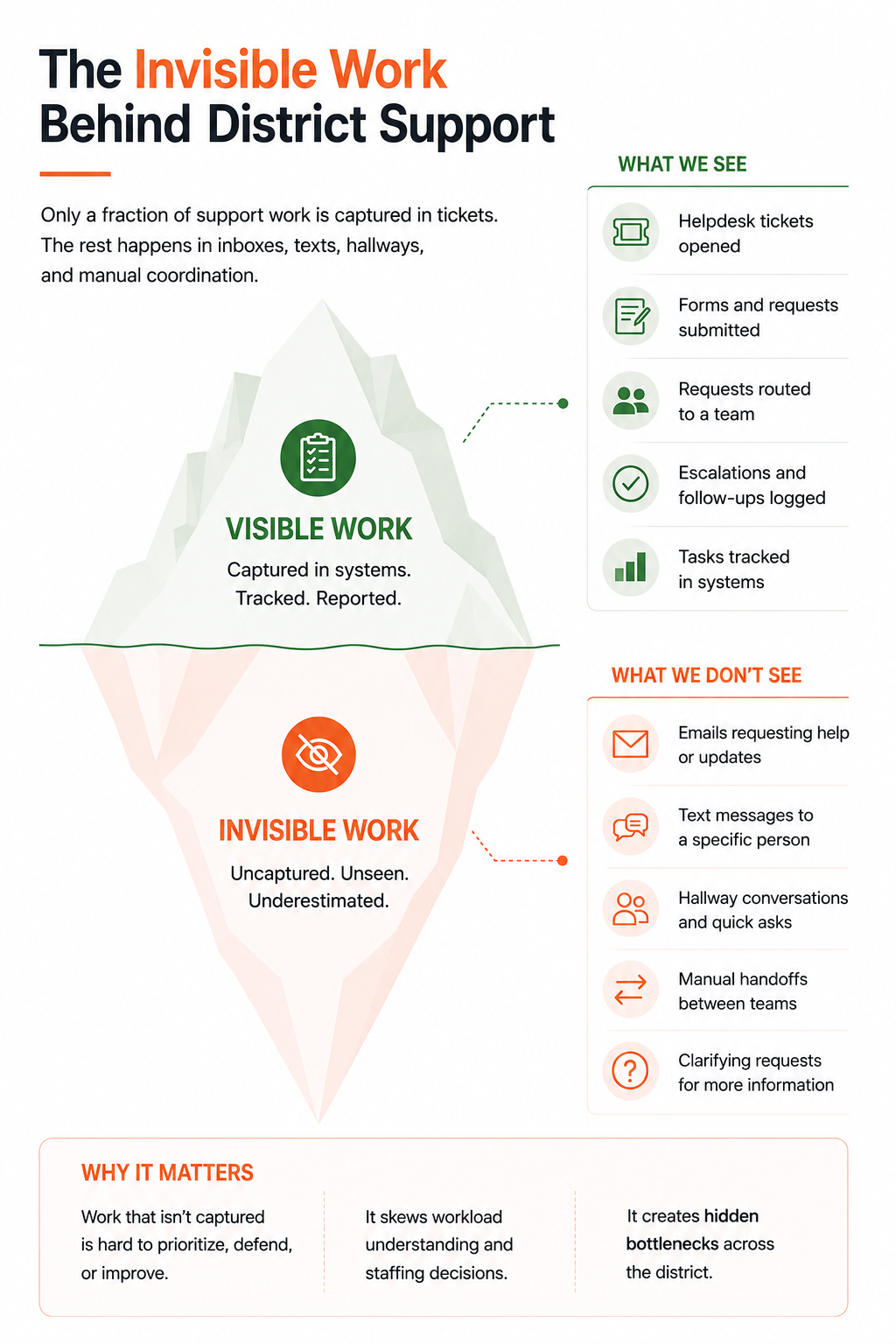
For district IT teams, the Hidden Work Calculator provides one way to begin quantifying the time consumed by invisible work that often goes unmeasured.
Burnout for Support Teams
Support staff frequently become the manual coordination layer between systems, departments, and stakeholders.
Large portions of the day can be spent triaging requests, clarifying context, forwarding information, following up manually, and tracking work across disconnected systems.
Over time, this operational overhead reduces capacity for strategic work and increases strain on already stretched support teams.
Inconsistent Support Experiences
Some requests are resolved quickly because they immediately reach the right person. Others stall because ownership is unclear or information gets lost during handoffs.
From the perspective of teachers, staff, students, and families, the support experience can feel unpredictable. People may not know where to go for help, whether anyone has seen their request, or when they should expect a response.
Over time, this inconsistency creates frustration and makes it increasingly likely that people will bypass district support systems.
Why Support Feels Disconnected Across the District
Most districts already have systems in place to support different operational needs.
IT, Facilities, HR, and Finance may each have their own tools and workflows for managing requests.
The challenge usually isn’t a lack of systems. It’s that the experience between them is disconnected. As a result, it’s unclear from the user’s perspective where to go for help or which department owns the issue.
Callout: Districts don’t need more systems. They need a more connected support experience.
Behind the scenes, this disconnect creates significant coordination challenges. Requests often require manual coordination between teams, systems, and workflows that were never designed to work together seamlessly.
What Better Operational Coordination Looks Like in Schools
Improving district support doesn’t require forcing every department into the same workflow or replacing every existing system.
But it does require creating a single starting point for support across the district.
Behind the scenes, requests may still move across different teams and systems. But the experience for the person seeking help should feel simpler and clearer.
Better operational coordination should include:
- one clear place to seek support
- intelligent request routing
- more consistent request context
- connected workflows
- shared visibility across teams
District support orchestration puts these pieces in place. As a result, issues are resolved faster, and the coordination burden required to move work effectively across the district is significantly reduced.
How AI Can Reduce Manual Support Coordination
AI is already helping districts improve school operations. It can also reduce the manual coordination required to support them.
In practice, this can include:
- answering common questions automatically
- guiding users to the right support path
- reducing duplicate requests
- capturing request context automatically
- identifying recurring operational patterns
- helping teams prioritize urgent issues
By taking on routine and repetitive tasks, AI can help support teams reduce the amount of manual coordination required to keep operations running smoothly.
And when routine questions and workflows become easier to manage, support teams gain more capacity to focus on higher-value operational and strategic work.
Moving Toward Operational Intelligence
When districts create a more connected support experience, they also create better operational visibility.
Over time, support interactions begin generating operational signals that help district leaders better understand how work moves across the organization. They can recognize:
- recurring issues
- workflow bottlenecks
- workload trends
- operational gaps
- areas where coordination consistently breaks down
This creates opportunities to not only improve responsiveness, but to also make more informed decisions.
Instead of relying on disconnected conversations and manual reporting, districts gain a clearer operational picture of what’s actually happening across teams and workflows.
Operational intelligence is built through connected operational workflows and visibility.
Start Improving Support Coordination Across Your District
District operations are harder to coordinate when support depends on disconnected conversations, fragmented intake channels, and manual routing between teams.
District teams are working hard enough. The problem is that the systems and workflows around them aren’t working as effectively as they could.
Improving operational coordination starts with creating a more connected support experience across the district. One where students, families, staff, and community members know where to start, and where support teams have better visibility into how requests move across the organization.
schoolOS gives districts one front door for support, so requests move more intelligently across the teams and systems already in place for district operations. Learn more.
FAQs
Why do school district support requests become fragmented?
Support requests become fragmented when different departments, workflows, and communication channels operate independently across the district. Requests may arrive through email, forms, phone calls, chat messages, or informal conversations, making coordination and visibility difficult.
What problems are caused by fragmented support workflows?
Fragmented support workflows can lead to delayed responses, duplicated work, inconsistent support experiences, reduced operational visibility, and work that is never fully captured or measured.
Why do people bypass helpdesk systems?
People often choose the fastest way to get help, especially when issues feel urgent, disruptive, or time-sensitive.
How can districts improve operational coordination?
Districts can improve operational coordination by creating a more connected support experience across teams, systems, and workflows. This often includes centralizing support intake, improving request visibility, reducing manual routing, and automating repetitive coordination tasks.
How can AI help school districts manage support requests?
AI can help districts manage support requests by answering routine questions, routing requests to the right teams, capturing request context automatically, and reducing the amount of manual coordination required across teams.
What is operational intelligence for K-12?
Operational intelligence for K-12 refers to using connected operational data, workflows, and support interactions to improve visibility, coordination, prioritization, and decision-making across district operations.

.png)