

By 10 a.m., your helpdesk queue is already backed up.
Your team spends the day triaging requests, routing issues, following up, and piecing together information just to keep things moving. A teacher can’t access a critical app. A cart of devices isn’t charging. A principal flags something urgent that needs immediate attention.
And the requests keep coming.
Behind the scenes, the systems meant to support this work are fragmented. Asset data lives in one place. Support tickets in another. Key decisions are tracked in spreadsheets, emails, or not at all.
Everything relies on people and manual coordination.
It works, until it doesn’t.
Requests pile up. Urgent issues get buried. Escalations come too late.
And the people responsible for keeping schools running are left managing the process instead of solving the problem.
Districts don’t need another tool. They need a better way to run operations.
This is where operational intelligence powered by agentic AI comes in.
What is Operational Intelligence?
Operational intelligence is the ability to see, understand, and act on what’s happening across district operations in real time, without relying on manpower and manual coordination.
Instead of relying on staff to triage requests, route work, and piece together information across systems, operational intelligence creates a unified platform where work moves forward automatically and insight builds continuously.
Operational intelligence is made possible by agentic AI that can understand context, take action, and learn from day-to-day operations.
At its core, operational intelligence brings together three essential capabilities:
Visibility
You have a real-time view of what’s happening across your district:
- What district assets exist and where they are
- What requests are coming in and their status
- Where work is stalled or at risk
Automation
Work moves forward without constant human intervention:
- Requests are routed automatically
- Tasks advance automatically based on logic and AI-driven decisions
- Routine issues are resolved without creating additional workload
Intelligence
The system continuously learns from your day-to-day operations:
- Patterns emerge across requests, assets, and workflows
- Risks are surfaced earlier
- Decisions are informed by real operational data
This is what separates operational intelligence from traditional tools. It’s a system that continuously improves how a district operates, without adding more burden to the people running it.
Operational intelligence: the ability to see, understand, and act on what’s happening across district operations in real time, without relying on manpower and manual coordination
Why Traditional K-12 Operational Systems Fall Short
Most school districts have no shortage of technology. They’ve invested in helpdesk systems, asset management tools, procurement processes, and other solutions intended to support day-to-day operations.
But even with all of these tools in place, operations still depend on people and manual coordination.
These are the problems schoolOS solves.
Fragmented Systems Create Blind Spots
In most districts, operational data is spread across multiple systems:
- Asset inventory lives in one platform
- Support tickets live in another
- Purchasing and budgeting exist in separate tools
- Critical context gets buried in emails, spreadsheets, or institutional knowledge
Each system captures part of the picture. But none of them show how everything connects.
So when something goes wrong, or starts to go wrong, there’s no clear way to see it early.
Teams are forced to piece together information manually, often under pressure, with incomplete context.
Manual Coordination Slows Everything Down
Because systems don’t connect or move work forward on their own, people have to step in at every stage to:
- Review and triage incoming requests
- Route issues to the right team or individual
- Follow up to keep work from stalling
- Manage handoffs between departments
This constant coordination is the invisible work that consumes their day.
The queue grows. Response times slow. Work gets stuck between steps.
Reactive Operations Increase Risk
When everything depends on manual coordination, operations become reactive by default.
- Issues aren’t surfaced until someone notices them
- Escalations happen only after something has gone wrong
- Small problems grow into larger disruptions
Without a system that continuously monitors and advances work, risk is always playing catch-up.
Decisions Are Made Without Complete Context
Without visibility, operational decisions, especially around purchasing, replacements, and resource allocation, are made on fragmented or outdated information.
- Devices are either replaced too early or too late
- Budget decisions rely on estimates instead of real usage patterns
- Trends across schools or departments are difficult to identify
Even experienced teams are forced to make judgment calls without a full picture.
When systems are disconnected and work doesn’t move on its own, everything depends on people and manual coordination to fill the gaps.
Operational intelligence addresses this at the system level by connecting data, automating workflows, and continuously generating insight from day-to-day operations.
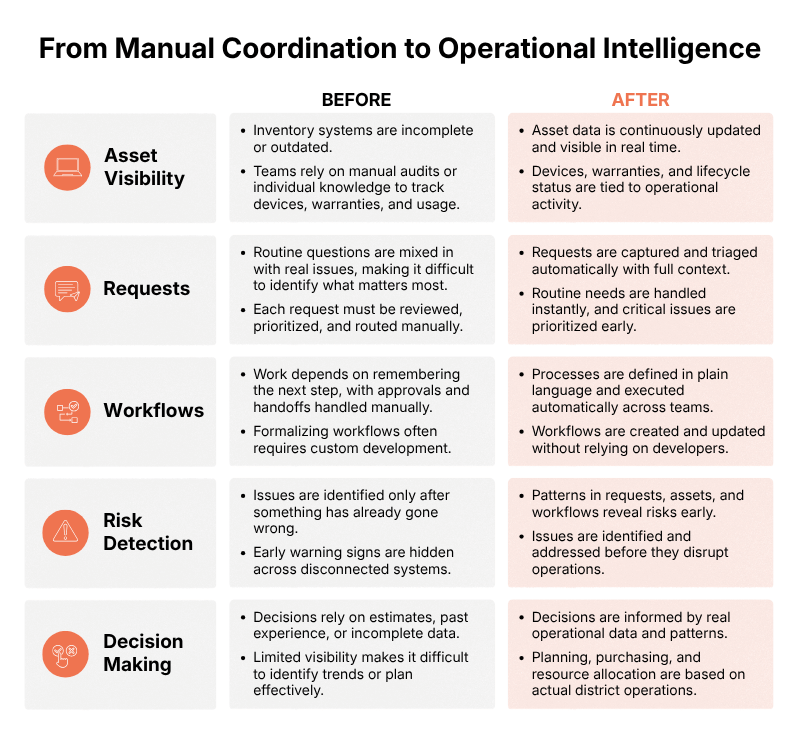
What Operational Intelligence Looks Like in Practice
Operational intelligence isn’t a new layer of reporting or another system to manage.
It changes how work moves through the district, reducing the need for manual coordination and allowing operations to run more smoothly day to day.
Here’s what that looks like in practice.
Asset Visibility Becomes Real-Time and Actionable
Before Operational Intelligence:
Inventory systems are incomplete or outdated. Teams rely on manual audits or individual knowledge to track devices, warranties, and usage.
After Operational Intelligence:
Asset data is continuously updated and connected to real operational activity.
- Devices are tracked across schools in real time
- Warranty and lifecycle status are visible without manual lookup
- Issues are tied directly to specific assets
Teams don’t have to search for information. It’s already there when they need it.
IT Support Requests Move Forward Automatically
Before Operational Intelligence:
Requests come in through multiple channels. Someone has to review, prioritize, and route each one. Routine questions take up time that could be spent on more urgent issues.
After Operational Intelligence:
Support requests are triaged and routed automatically based on context, urgency, and historical patterns.
- Routine questions are resolved instantly
- Urgent issues are surfaced and prioritized
- Tickets arrive with the right context already attached
Instead of managing the queue, teams can focus on resolving what’s most critical.
Workflows Advance Without Constant Follow-Up or Manual Intervention
Before Operational Intelligence:
Work depends on someone remembering to take the next step. Approvals, handoffs, and follow-ups happen through emails, messages, or manual tracking.
After Operational Intelligence:
Workflows advance automatically across teams and systems.
- Tasks move forward based on predefined logic or AI-driven decisions
- Approvals are triggered without manual coordination
- Handoffs happen without delays or dropped context
- Workflows are created without development, using plain-language inputs
Work doesn’t stall between steps. It keeps moving.
Risks Are Surfaced Earlier
Before Operational Intelligence:
Problems aren’t identified until after something has already broken, failed, or disrupted learning.
After Operational Intelligence:
Patterns and signals across operations surface potential risks early.
- Repeated issues with specific devices or locations are flagged
- Bottlenecks in workflows become visible
- Emerging problems are identified before they become urgent
Teams can act proactively instead of reacting under pressure.
Decisions Are Informed by Real Operational Data
Before Operational Intelligence:
Decisions about purchasing, replacements, and resource allocation rely on estimates, past experience, or incomplete data.
After Operational Intelligence:
Decisions are grounded in patterns from actual day-to-day operations.
- Replacement cycles reflect real usage and failure rates
- Budgeting is informed by actual demand and trends across the district
- Leaders have a clearer picture of what’s really working and what isn’t
Instead of guessing, teams can plan with confidence.
Work no longer depends on people to manually coordinate every step. The platform moves work forward, and it continuously learns as it operates.
To make this possible, districts need more than individual tools. They need a system built around a different set of capabilities.
The Core Capabilities of an Operational Intelligence Platform
Operational intelligence is defined by a set of capabilities that work together to improve how operations run across the district. These capabilities reduce reliance on manual coordination and enable work to move forward more effectively.
At a high level, an operational intelligence platform should deliver four core capabilities.
Truly Unified Operational Visibility
Without unified visibility, teams are forced to rely on fragmented systems and manual effort to understand what’s happening. With it, they gain a complete, real-time view of what’s happening across the district.
This goes beyond static reports or isolated dashboards. It means bringing together data from assets, support requests, workflows, and systems into a single, connected view.
- See what’s happening across schools, departments, and teams
- Understand the current status of requests, assets, and work in progress
- Identify where work is bottle necking or at risk
Workflow Automation
Intelligent workflow automation moves work forward without constant human intervention. This is made possible by agentic AI, which can take action across systems rather than simply responding to inputs.
Workflows advance automatically based on logic, rules, or AI-driven decisions.
- Requests are triaged and routed without manual review
- Tasks progress across teams and systems automatically
- Approvals and handoffs happen without delays
Workflows aren’t just managed. They’re defined and executed by the system. This reduces the operational burden on staff and ensures work doesn’t stall between steps.
Intelligent Support and Resolution
Operational intelligence uses AI to resolve common issues instantly and provide context-aware support across the district.
- Routine questions are answered without creating tickets
- Requests are enriched with relevant context before reaching staff
- Support becomes faster, more consistent, and more scalable
By providing a more efficient way to handle incoming requests and routine needs, operational intelligence allows teams to focus their time on higher-value work.
Continuous Learning and Insight
Operational intelligence transforms day-to-day operations into actionable insights.
Instead of relying on static reports, the system continuously analyzes patterns across requests, assets, and workflows to surface insights.
- Identify recurring issues and systemic bottlenecks
- Surface risks earlier based on emerging patterns
- Inform decisions with real operational data
Over time, the system becomes more effective because it’s learning from how the district actually operates.
The Difference
Most districts already have tools to provide discrete capabilities:
- Asset management systems provide visibility
- Helpdesk tools manage requests
- Workflow tools automate specific processes
But these tools are disconnected and operate in isolation.
Operational intelligence connects these capabilities into a single system. And when these capabilities come together, the impact is clear:
- Work flows continuously
- Insight builds over time
- Operations improve without adding manual effort
The Benefits of Operational Intelligence for Districts
When district operations no longer depend on manual coordination, the impact is immediate.
Work moves more predictably. Issues are surfaced earlier. And the people responsible for keeping schools running can focus on what actually matters.
Reduce Burnout
In most districts, operational work is defined by constant triage.
Teams spend their days reviewing requests, routing issues, following up, and trying to keep work from slipping through the cracks. It’s repetitive, interrupt-driven, and difficult to sustain.
Operational intelligence removes much of that burden.
- Fewer routine requests require manual support
- Work moves forward without constant follow-up
- Staff spend less time managing the process
Instead of reacting all day, teams can focus on resolving bigger issues and improving operations.
Avoid Surprises
When systems are disconnected and work depends on manual coordination, problems often surface too late.
A device failure becomes widespread before it’s noticed. A bottleneck builds until it disrupts multiple teams. An issue escalates only after it impacts classrooms.
Operational intelligence changes that:
- Risks are surfaced earlier based on real patterns
- Bottlenecks become visible before they slow operations
- Emerging issues are identified before they escalate
Instead of reacting to problems, teams can see them before they happen.
Operate with Confidence
Without a clear, connected view of operations, decisions are often made with incomplete information and are delayed as teams pull data together.
Leaders spend hours or even days gathering inputs from multiple systems, relying on estimates, past experience, or fragmented data to plan budgets, allocate resources, or prioritize initiatives.
In practice, this often leads to rule-based decisions:
- Devices are refreshed on fixed timelines
- Resources are allocated based on assumptions
- Issues aren’t addressed until after they surface
Operational intelligence provides a stronger foundation:
- Decisions are informed by real operational data
- Trends are visible across schools and departments
- Planning is based on what’s really happening in the district
Instead of relying on rules, districts shift from rule-based decisions to data-driven decisions grounded in real operational conditions.
With better visibility and continuous insight, decisions can be made more quickly, more reliably, and with greater confidence.
And the best part? These benefits aren’t the result of working harder or adding more tools. They come from changing how operations run at the system level.
Why K-12 Districts Are Moving in This Direction Now
The challenges facing district operations aren’t new. What’s changed is the scale, complexity, and expectations surrounding them.
For many districts, the traditional model of relying on people and manual coordination to keep operations running is no longer sustainable.
Several forces are driving this shift.
Increasing Operational Complexity
District operations have become more complex over time.
- 1:1 device programs have expanded the number of assets to manage
- More digital tools mean more access issues, integrations, and support requests
- Workflows now span multiple systems, teams, and departments
What used to be manageable with manual processes now requires a more coordinated, system-level approach.
Staffing Constraints and Burnout
At the same time, many districts are operating with limited staff due to budget reductions, and with no relief on the horizon.
IT and operations teams are expected to support more users, more devices, and more systems, often without a corresponding increase in resources.
- Teams are stretched thin
- Hiring and retention are ongoing challenges
- Burnout is becoming harder to ignore
Relying on manual coordination under these conditions only increases the strain.
Rising Expectations from Schools and Communities
The expectations placed on district operations have also shifted.
- Teachers expect faster resolution when issues disrupt instruction
- School leaders expect greater visibility into what’s happening across their buildings
- Families expect reliable access to digital tools and resources
When systems are slow or disconnected, the impact is immediate.
Instruction is delayed. Class time is lost. Students are left waiting while issues are resolved.
Delays, disruptions, and uncertainty are not only more visible, but they’re also less tolerated than they were in the past.
Pressure to Do More with Limited Budgets
Districts are under constant pressure to maximize the impact of limited resources.
Operational inefficiencies from time spent on manual coordination, duplicated work, and delayed resolutions carry real costs.
- Time lost to inefficiency reduces capacity
- Poor visibility leads to misaligned spending
- Reactive decisions increase long-term cost
Improving how operations run isn’t just a technical issue. It’s a financial one.
The Emergence of AI as an Enabler
Agentic AI enables a fundamentally different approach: systems that can understand context, take action, and continuously learn from day-to-day operations. It can:
- Understand context
- Route and prioritize work
- Learn from patterns across operations
This is what enables operational intelligence.
Operational intelligence doesn’t simply add AI to existing tools. It uses an AI-native approach to reduce reliance on manual coordination and improve how work moves across the system.
Operational intelligence is enabled by agentic AI, which means systems can take action, not just provide insight.
Individually, each of these pressures is manageable. But together, they create an inflection point.
Districts can continue to rely on disconnected tools and manual coordination. Or they can make the shift to a system designed to handle the complexity of modern operations.
How schoolOS Delivers Operational Intelligence
schoolOS delivers operational intelligence through a truly unified platform that connects requests, asset data, and workflows, then continuously turns that activity into insight.

A Single System for District Operations
In most districts, asset data, support requests, and workflows exist in separate systems.
schoolOS unifies these into a single operational platform:
- Assets, requests, and workflows are connected
- Data flows across systems instead of staying siloed
- Work progresses with full context, not fragmented information
This creates a shared foundation for how operations are managed across the district.
Work That Moves Automatically
Operational intelligence depends on more than visibility. It requires work to move forward without constant intervention.
schoolOS enables this through intelligent workflow orchestration:
- Requests are triaged and routed automatically
- Tasks advance across teams and systems
- Approvals and handoffs happen without delays
Instead of relying on people to coordinate each step, the system keeps work moving.
Free Up Time for Higher-Value Work
A significant portion of most districts’ operational workload comes from routine requests and questions.
schoolOS uses AI to reduce that volume and improve how support is delivered:
- Routine questions are resolved instantly
- Requests are enriched with context before reaching staff
- Support becomes faster and more consistent across the district
This reduces the volume of routine work and allows teams to focus on more complex issues and strategic priorities.
Insight That Builds from Daily Operations
Operational intelligence isn’t static. It improves as the system learns from day-to-day operations, but it also begins delivering value immediately.
schoolOS continuously generates insight from day-to-day activity:
- Patterns across requests, assets, and workflows are surfaced
- Bottlenecks and risks become visible earlier
- Decisions are informed by real operational data
Over time, the unified operational intelligence platform becomes even more effective as it learns from how the district actually operates.
And the best news? Districts can make the transition to operational intelligence in a phased way, without disrupting their current operations.
Make the Shift from Manual Coordination to Operational Intelligence
Many districts depend on people to bridge the gaps between disconnected systems, manual workflows, and incomplete information.
They’ve made that model work, but only because there wasn’t a better way.
Now there is. And districts are beginning to make the shift.
FAQs
What is operational intelligence in K-12?
Operational intelligence in K-12 is the ability to see, understand, and act on district operations in real time by connecting data, automating workflows, and generating continuous insight, without relying on people and manual coordination.
How is operational intelligence different from traditional tools?
Traditional tools operate in silos and require manual coordination to connect data and move work forward. Operational intelligence uses agentic AI to bring asset data, requests, and workflows into a unified system that moves work forward and continuously learns from daily operations.
How can districts get started with operational intelligence?
Most districts begin by rethinking how support requests are handled. That’s where much of the day-to-day operational load originates, and unnecessary tickets create noise. District Support Orchestration provides a practical starting point by making it easier to answer, route, and coordinate requests across the district.
As more operational data and workflows are brought into the system, insight builds, enabling better decisions around planning, purchasing, and resource allocation.
Run District Operations with Intelligence
See how the schoolOS operational intelligence platform helps districts see operations clearly, move work forward, and make smarter decisions.

.png)