
Our technology department has lost six staff members over six years. We’ve reached the point where those reductions have changed how we provide support to our schools.
We used to have technicians in their buildings every day, checking on how things were going and addressing problems proactively. This year, we moved to a reactive model, prioritizing tickets and sending technicians where they’re needed most.
That’s a tough change for a department that prides itself on customer service.
People may know we’ve cut staff. They may understand that things could take longer. But when they need help, there’s still an expectation that we’ll provide the same level of support.
We want to meet that expectation, too. The question is what we can change about the work so our remaining team has more capacity to provide it.
Look Closely at the Work That Keeps Coming Back
At the beginning of the school year, we get flooded with requests from teachers and other staff who have forgotten their passwords. In some cases, they have tools to resolve the problem themselves. But they’re accustomed to calling our help desk because they know they’ll get friendly, helpful support.
That’s a good thing about our team. It also takes time.
I asked one of our help desk technicians another question: What percentage of the calls you take have nothing to do with our department?
The estimate was 20–25% at the beginning of the school year. Those calls belonged to student information systems, payroll, or HR. But the number everyone remembers is the help desk, because they know someone there will help.
During back to school, 20-25% of the calls we receive have nothing to do with our department.
So our staff spend time getting people to the right place before they can get back to the work that actually needs them.
These tasks creep up on you. You get used to answering the same questions and directing the same requests until it feels like a normal part of the day.
My recommendation is to ask the people answering your phones what they hear repeatedly. You may find opportunities to give them time back for equipment needs, onboarding, and other support that requires their attention.
Let Your Ticket History Challenge Your Assumptions
As we looked at schoolOS, their team reviewed our help desk tickets. That analysis identified 42% as potentially addressable through knowledge resources or automated processes.
This helped us see how much of our ticket volume involved recurring needs and gave us something to work toward.
If you’re looking for ways to improve district IT support with fewer staff, your ticket history is a useful place to start.
Of the tickets reviewed, 42% were identified as potentially addressable through knowledge resources or automated processes.
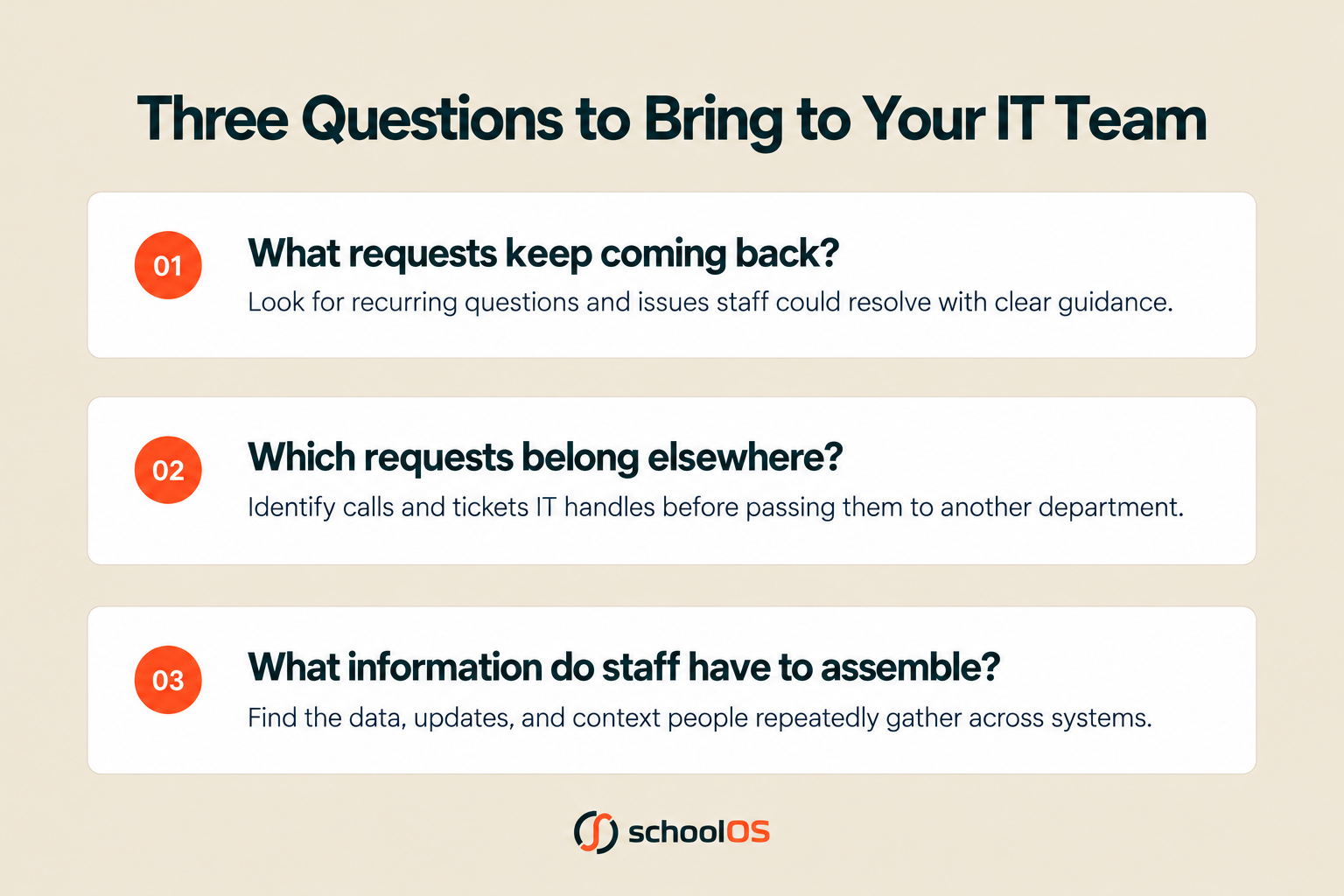
Which questions keep coming back? Could staff resolve some of those issues if the instructions were easier to find? Which requests require technical work, and which need an answer or a connection to another department?
Those questions can help you focus on changes that would make a difference to your team.
Consider What Connected Information Could Change
When schoolOS first approached me, I wasn’t immediately convinced we needed another solution. We were keeping our heads above water. With everything already on our plate, it was reasonable to ask why we should take on something new.
Then my assistant, who had been sorting our tickets and handling a lot of work behind the scenes, joined me for a demo.
During the schoolOS demo, my assistant sent me a text saying, “When can we get this?”
We both saw how bringing asset information, ticketing, and district knowledge together could help us become a more effective department. That’s what interested us in schoolOS’ Operational Intelligence platform: the ability to connect information from different systems and make it available when and where our team needs it.
We have developers who could connect some of that information ourselves. But that would pull them away from other projects. And we'd need a plan to maintain whatever we built as people leave, priorities change, or departments face more cuts.
As I wrote in The Data Is There. That’s Not the Problem., having the information is also only one part of the equation. Making it usable without repeatedly pulling it together by hand is where the opportunity lies.
The value extends to the people seeking help. schoolAgent, the agentic AI component of the schoolOS platform, provides a shared front door for district questions and support requests. We see an opportunity for staff to use it to find information, submit a request, or check its status without navigating to another system.
That’s less navigation for them and a simpler way to stay informed.
Test the Questions Your Community Actually Asks
Testing an agent on our district website also showed us where our information needed attention.
I asked when the next volleyball game was at Capital High School. The event hadn’t been put on the calendar, so the information wasn’t there to answer the question.
That gave me something concrete to take back to the school. If we want the community to attend these events, we need to make the details available.
As part of our schoolAgent implementation, testing everyday questions has already helped us identify gaps in the information available on our website.
If your district is exploring AI-supported self-service, test what families, staff, and community members actually want to know. An unanswered question can show you something useful about the information you’re providing.
Step Back With the People Doing the Work
Every district’s systems and processes are different. What makes sense for Olympia may not be exactly what makes sense for yours.
But I’d encourage any district IT leader facing staffing pressure to step back with their team and take an objective look at how support works.
Include the people answering calls, sorting tickets, and helping users find their way. Ask what has become routine simply because you’ve always done it that way. Then ask what could make the department more effective.
Our team wants to provide excellent service. Finding ways to reduce repetitive work and make information easier to access is part of how we’re working toward that goal.
Hear more from Marc: Watch the Olympia School District webinar for the full conversation behind this article and a demonstration of schoolOS. Watch the replay →